Showing posts with label climate change. Show all posts

Tuesday, April 16, 2013

Twitter Conversation Of The Day

Proof that I am spending too much time watching Twitter today:


Twitter Conversation by emptywheel, April 16, 2013

The crap is going to happen anyway, so you might as well laugh about it.

I took a screenshot, because blogger still doesn't have a tool to include Twitter messages inline. If you want to follow the links, go to the link in the byline.

Tuesday, March 19, 2013

Climate Change Update: March 19, 2013

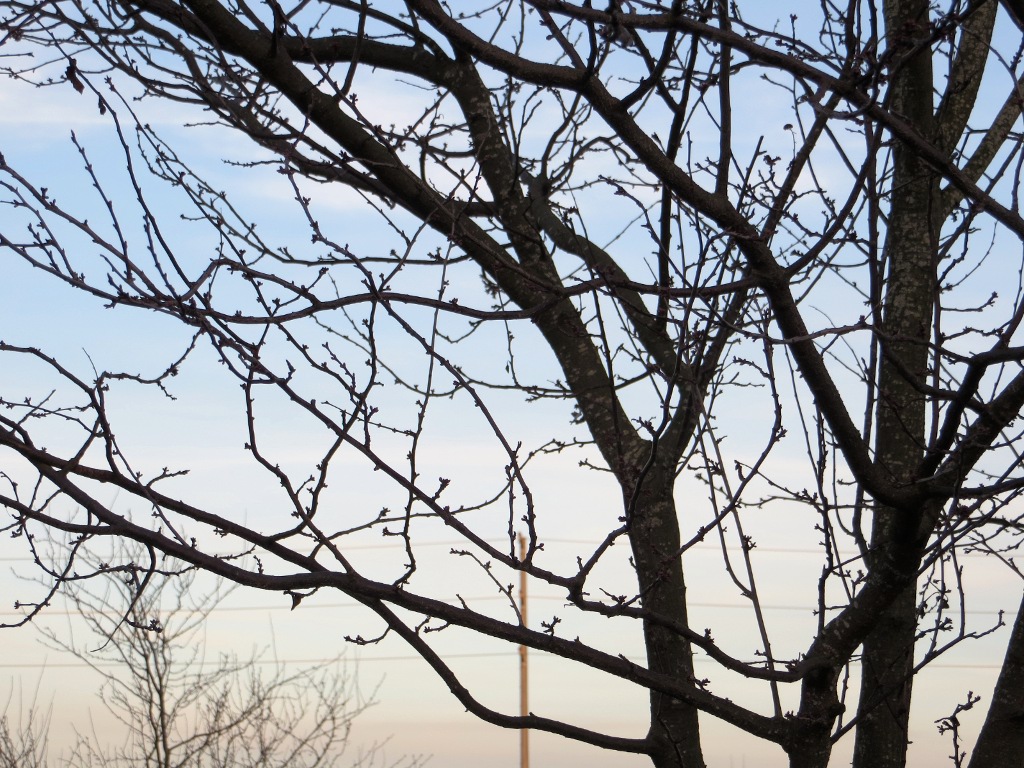
The measurements are in, the science done. Here's photographic proof:

Image credit: All photos taken and processed by Cujo359

Friday, February 1, 2013

Climate Change Update

Caption: The Climate Change Cherry Tree. Like a commons that isn't really a commons, a clock that looks like a tree stump, and transmission lines, it's one of the many wonders of downtown Federal Way, WA.

Image credit: Cujo359

In yet another excursion to downtown Federal Way in which the main purpose was to get out of the house, I took some photos readings at the by now world famous Climate Change Cherry Tree. As readers will recall, we recently visited another location in Federal Way and noted, much to our surprise, that there were blooms on one of the local cherry trees there.

Three years ago, buds were starting to bloomon February 17.

Saturday, January 26, 2013

No Climate Change To See Here

While trying to photograph a passing airplane yesterday, my camera caught this instead:

Image credit: Cujo359

Yes, those are cherry blossoms, in January. It's not the Climate Change Cherry Tree, but it's only a few blocks away. We can't say this is a scientific study without an official observation at the CCCT, of course, but it's sure looking like spring will be here really early this year.

Friday, December 23, 2011

Hope You Don't Mind Brown For Christmas ...

Caption: My front yard on Christmas day, back in 2008. This will be an increasingly rare sight in the years to come.

Image credit: Cujo359

Looks like Think Progress has found another measurement of climate change to supplement the not-quite-universally recognized Climate Change Cherry Tree:
This winter has been unusually warm, crippling ski resorts, ruining holiday traditions, and dashing hopes of a white Christmas across the northern hemisphere. While the billions of tons of greenhouse pollution in our atmosphere sometimes encourage freak snowstorms, the primary effect of global warming on winter is, well, warmer temperatures — making white Christmases less likely.

Global Warming Hates A White Christmas
Locally, the National Weather Service is predicting rain for Christmas day.

Seems like one of the costs of our continued dependence on fossil fuels will be fewer white Christmases and less opportunity to engage in winter sports that can't be played indoors.

Personally, even this doesn't cost doesn't seem worth it to me.


Friday, March 11, 2011

Another Climate Change Update

Caption: The Climate Change Cherry Tree, in a strip mall somewhere in Federal Way, Washington. It's way behind last year's pace, proving that there's no global warming this year. Click on the image to verify the data.

Image credit: All photos by Cujo359

Since the last time I reported on the state of climate change, the weather has been rather ugly on the rare days when I could get out to look at the climate change cherry tree. As all right wing gasbags and and most climate change deniers could tell you, whether there is climate change or not isn't a matter of recording the temperature all over the world and then seeing if the average is rising or not, but instead is a matter of checking conditions in one's own area and assuming that this how things are in the rest of the world, I thought I'd post another update based on conditions in the Pacific Northwest.

Caption: Close up view of CCCT blooms. Things are right on schedule.

You'll be happy to know that the world is not getting warmer this year. As you can see from the state of the Climate Change Cherry Tree (CCCT), it's blooming at least three weeks later than it was last year. Here is a close up of the buds. This is about the schedule I'm used to - the cherry trees usually bloom in mid- to late March, and that looks to be about what will happen this year.

Caption: Outside the state liquor store, this tree proudly shows all those tree-hugging hippie scientists that things are back to normal in the world.

Here are a couple more trees from that same area. Historically, these trees have been a week or so ahead of the CCCT, and they're almost fully in bloom now.

Caption: Nothing says "Averages? We don't worry about what's average around here!" like a cherry tree blooming at the usual time outside a Hallmark store.

Anyway, what with all the bad news these days, I thought everyone could use a little cheering up.

Click on the pictures to enlarge.


Sunday, February 20, 2011

Climate Change Update

This is the same cherry tree that I photographed last year at around this time:

Image credit: Cujo359

As that link shows, this tree was blooming on February 17 last year. Clearly, there are no blossoms yet. From the condition of the buds:

Image credit: Cujo359

It looks like it will be a few more days before they blossom.

I guess there's no global warming this year...


Wednesday, June 16, 2010

Climate Change Update

Looks like global warming isn't happening this week:
Image credit: Screenshot of U.S. Weather Service forecast page by Cujo359

[Click to enlarge.]

I have a friend who moved here recently. The last couple of late Junes have been unusually dry and warm. I've had to explain that this sort of weather is more normal.

So, clearly climate change isn't happening this month.

Yes, this bad joke will continue until our nation's pundits get a clue about what "climate" means. What's hard to imagine is that in the nation's capital, where presumably people would be somewhat more attuned to what's going on in the rest of the country than normal, people actually seem to be just as provincial in their outlook as the most isolated villages in Appalachia.


Friday, March 26, 2010

What's All The Fuss About?

In all the sturm und drang over climate change, and how it will inevitably lead to international disputes, no one ever mentions that it might actually solve a few:

A tiny island claimed for years by India and Bangladesh in the Bay of Bengal has disappeared beneath the rising seas, scientists in India say.

The uninhabited territory south of the Hariabhanga river was known as New Moore Island to the Indians and South Talpatti Island to the Bangladeshis.

Recent satellites images show the whole island under water, says the School of Oceanographic Studies in Calcutta.

Disputed Bay of Bengal island 'vanishes' say scientists

Hard to believe it was worth fighting over if it floods so easily:

New Moore – or South Talpatti – sat in the Sundarbans mangrove delta in the mouth of the Hariabhanga River that divides India and Bangladesh.

It is thought to have been created by a cyclone only about 40 years ago – and was never more than two metres above sea level at its highest point.

There were no permanent structures on the island, but in 1981 the Indian Navy planted its national flag there.

New Moore Island is no more as climate changes ends ownership dispute

The seas haven't risen two metres (roughly 6ft.), what apparently has happened is that the river is getting higher. Sea levels have been rising about 5 mm a year, according to the Times Of London article. That means the seas have risen a couple of inches in the last decade. Still, climate change causes other changes besides rising sea levels, and this island appears to have been one of the earliest victims.

But this clearly isn't a sign that the world is getting warmer, because it's not an island in Washington, DC.

(h/t Naked Capitalism)


Tuesday, March 9, 2010

Did The Climate Change Today?

There were snow flurries in my neighborhood yesterday. I caught this image of them before they disappeared. It's supposed to get down close to freezing tonight.
Image credit: Cujo359

I'm confused, though. Since this didn't happen where Sean Hannity lives, either, does it mean that there really isn't such a thing as global warming?

Actually, a little snow in March isn't all that unusual out here. What's unusual is that we had such warm weather the last two months.


Wednesday, February 24, 2010

Climate Change Update

Image credit: Cujo359

This is the cherry tree I photographed a week ago. As you can see, it's in full bloom, at least a week ahead of the earliest I can remember seeing these blossoms. Over at Two Ton Green Blog, Suzanne reports that the daffodils are up as early as she's ever seen them, and she used to live in California.

As anyone who has been watching the Winter Olympics is probably aware, this has been one of the warmest winters ever in this part of the world:

The Pacific Northwest Canadian city[,] which will host the games from today through February 28, 2010[,] just experienced its warmest January since record keeping began in 1937. Temperatures averaged 44.8 degrees Fahrenheit (7.1 degrees Celsius), considerably warmer than the average of 37.9 degrees Fahrenheit (3.3 degrees Celsius). Average February temperatures for Winter Olympic host cities are typically below freezing.

Vancouver 2010 to Be Warmest Winter Olympics Yet

It's just as unusually warm on this side of the border:

SEATTLE -- It's the worst-kept surprise party in Seattle -- the city officially set a record for the warmest January on record.

The average temperature was 46.97 degrees -- toppling the record of 46.56 degrees set in 2006, and a full six degrees above the normal average of 40.9 degrees. In fact, it's even warmer than a typical March! (which has an average temperature of 46.2 degrees.)

January Was Warmest On Record In Seattle

It's looking to be one of the warmer Februaries, too.

Last month, various Fox "News" personalities suggested that Al Gore and all those climate scientists don't know what they're talking about because it was snowing back East. That would certainly imply that those Fox "News" clowns don't know what they're talking about either.

The same "logic" certainly applies.

Afterword: Yes, I keep harping on this. Rank stupidity deserves to be called out, particularly when it endangers those of us who aren't too stupid to listen to the people who study these things, instead of ridiculing them for telling us things we don't want to hear.


Wednesday, February 17, 2010

To All The Climate Change Deniers

Image credit: Cujo359

See this cherry tree? I took this photo today. There are blossoms already. This thing will probably be in full bloom before March arrives. When I first moved to this area eighteen years ago, this was happening in mid-March, not mid-February.

This has been one of the mildest, if not the mildest, winters I've experienced in the Northwest. It followed one of the hottest summers. It might be cold on the East Coast at the moment, but it's warm out here, and has been for some time.

So, the next time you want to call people who are warning you that the world is warming up stupid, or shrill, just because it happens to be cold and snowy where you are at the moment, I suggest you think about the cherry blossoms. Out here. Then contemplate what "average" means.


Saturday, November 21, 2009

The CRU Breakin

The recent break in of the e-mail server at the Climate Research Unit (CRU) of the University of East Anglia brings a couple of thoughts to mind. I'm in a hurry now, so I'll try to be brief, and will avoid using links for the most part.

First of all, stealing the contents of e-mail from a server is a criminal act, both in the United States, and in the United Kingdom, which is the jurisdiction where the computer apparently resides. I say "apparently", because it's at least theoretically possible that the data were also stored off-site in some foreign country. While it's a far-fetched possibility, it's not impossible as far as I know.

Given that the contents were obtained illegally, there has to be some doubt as to its authenticity. That's bad news for anyone trying to make a point using the supposed contents of this e-mail. Most conventional e-mail servers don't provide any means of discerning whether the contents have been changed. E-mail consists of a header portion and a main body that contains the actual message. Sometimes, as is the case with sendmail, those two parts are kept in separate files. There is no checksum, or other means, to ensure that the files have been preserved. Administrators are usually careful to ensure that hard disk problems don't make a mess of things.

In short, if I had access to this data, I could easily alter much of it to suit my fancy, and there would be no direct evidence I had done so beyond checking other copies of that information that were beyond my control.

Any point someone is trying to make using these e-mails should be viewed skeptically. The burden of proof is on them to show that the contents are genuine. If the people who wrote the e-mails confirm their contents are genuine, that can be counted as proof, and at least to a limited degree, they have. But if any new "revelations" occur in the next few days regarding the contents of that e-mail, the likelihood of fraud should be in everyone's mind.

Nate Silver has provided some perspective as a statistician on what is supposedly the most damning e-mail to emerge from this pile of data. It's worth looking at, I think, since this supposed e-mail has garnered so much attention.


Wednesday, July 29, 2009

It Isn't Hot Here, No Siree...

Image credit: Screenshot of NWS forecast by Cujo359

No, it isn't unusually hot out here in the Pacific Northwest today:

[W]ill a record be broken today or not?

The all-time high temperature of 100 degrees in Seattle was set July 20, 1994.

Official temperature records have been kept locally since 1894, and back then official temperatures were taken at the Federal Building in downtown Seattle.

So it's been 115 years of not one single 100-plus-degree day.

Heat Wave Puts High Pressure On Weather Forecasters

As this article mentions, it's unusual around here for the temperatures to be above 90 degrees Fahrenheit (32o C). We usually get a few such days in summer. It's a once in a century event to have a day over 100o F (38o C). Clearly, it's an unusual phenomenon.

So, do you think all the putzes who complain about how it hasn't been hot recently so there must not be any such thing as climate change will be noting this record heat wave? Not bloody likely. Nate Silver of Five Thirty-Eight, who is a statistician, took one of them to task a couple of weeks ago:

John Hinderaker at the popular conservative blog PowerLine reports that it's been cold, cold, cold in his home town of Minneapolis, Minnesota, going to far as to compare it with "The Year Without a Summer", 1816, when global temperatures were abnormally low as a result of the eruption of Mount Tambora:

I don't think things are quite so bad this year, but if something doesn't change pretty soon 2009 may go down in history, in some parts of the U.S. at least, as another year with barely any summer. Here in Minnesota and across the Midwest, temperatures are abnormally cold. I don't know whether the phenomenon is world-wide--data that will answer this question have probably not been assembled, and may not be honestly reported--but the current low level of solar activity suggests that the cooling trend could indeed be universal.

Indeed, it's been pretty cool in Minneapolis for the past couple of days; the temperature hasn't hit 70 since midday Thursday. But has it been an unusually cool summer? No, not really. Since summer began on June 21st, high temperatures there have been above average 15 times and below average 13 times. The average high temperature there since summer began this year has been 82.4 degrees. The average historic high temperature over the same period is ... 82.4 degrees. It's been a completely typical summer in Minneapolis, although with one rather hot period in late June and one rather cool one now.

A Challenge to Climate Change Skeptics

[link from original]

This is the sort of dishonesty typical of warming deniers. They cherry-pick a few bits of data that supports their premise, and ignore the rest. I tend to resist using the term "global warming", because it's a misnomer. A globe is a model of the world, not our world itself. Nevertheless, that name for the phenomenon evokes the idea that this is happening over the world as a whole, not in one little portion of it.

Nowhere is this better demonstrated than by the response to the challenge Nate referred to in that article. It was to writers of major blogs (those with an Alexa ranking of 50,000 or lower). The challenge he issued was this:

The rules of the challenge are as follows:

1. For each day that the high temperature in your hometown is at least 1 degree Fahrenheit above average, as listed by Weather Underground, you owe me $25. For each day that it is at least 1 degree Fahrenheit below average, I owe you $25.

2. The challenge proceeds in monthly intervals, with the first month being August. At the end of each month, we'll tally up the winning and losing days and the loser writes the winner a check for the balance.

3. The challenge automatically rolls over to the next month until/unless: (i) one party informs the other by the 20th of the previous month that he would like to discontinue the challenge (that is, if you want to discontinue the challenge for September, you'd have to tell me this by August 20th), or (ii) the losing party has failed to pay the winning party in a timely fashion, in which case the challenge may be canceled at the sole discretion of the winning party.

A Challenge to Climate Change Skeptics

In other words, over a stretch of time more meaningful than a few days, he was willing to bet that temperatures would be warmer than average more often than not, at least if he had people betting against him from more than one place.

To date, not one of them has accepted the challenge, but what one right wing blogger attempted to do demonstrates the intellectual dishonesty of their arguments:

I did get a few feelers, most notably from Tom Maguire at JustOneMinute.com, who was willing to take the wager provided that we made the location Minneapolis, rather than his hometown of New York. This was smart of Tom, since Minneapolis is one of the few areas of the country projected to have below-average temperatures over the next 30-60 days. Unfortunately, I am smart too, so I turned him down. You can read more of the friendly exchange we had at his site.

Climate Challenge Update

[links from original] Maguire cherry-picked the data. Go figure.

So, I don't expect that we'll be hearing much from these folks about the heat wave in the Pacific Northwest. When we do, all of a sudden they'll remember that the warming or cooling of the earth happens at a more significant period than a few days, and they'll pick a slightly longer one. Either that, or they'll point out that it's cooler in Minneapolis.

Of course, the truth is that even the results of these challenges don't mean much individually. It's the dishonest attempts to cherry pick the data that are interesting. The truth is that the world's average temperature has been getting warmer for some time, as this chart demonstrates:


This is a chart of this data, which was collected and compiled by the NASA Goddard Spaceflight Center.

Clicking on that last link will take you to the NASA GSFC main page on the Earth's surface temperature. Every chart shows an increase in temperature. Charts that go back to the late 19th Century all show this trend, whether the information is compiled from weather station data or sea surface temperature measurements. Satellite surface temperature measurements confirm that trend, at least for the relatively short time they've been available. What's more, as this paper notes, that change can be attributed to greenhouse gases:

Global surface temperature has increased ≈0.2°C per decade in the past 30 years, similar to the warming rate predicted in the 1980s in initial global climate model simulations with transient greenhouse gas changes. Warming is larger in the Western Equatorial Pacific than in the Eastern Equatorial Pacific over the past century, and we suggest that the increased West-East temperature gradient may have increased the likelihood of strong El Niños, such as those of 1983 and 1998. Comparison of measured sea surface temperatures in the Western Pacific with paleoclimate data suggests that this critical ocean region, and probably the planet as a whole, is approximately as warm now as at the Holocene maximum and within ≈1°C of the maximum temperature of the past million years.

Abstract Of Hansen, et. al, 2006

What do those models predict will happen in the near future? More of the same, I'm afraid:

This quote from the paper explains what those different scenarios mean:

The congressional testimony in 1988 (13) included a graph (Fig. 2) of simulated global temperature for three scenarios (A, B, and C) and maps of simulated temperature change for scenario B. The three scenarios were used to bracket likely possibilities. Scenario A was described as "on the high side of reality," because it assumed rapid exponential growth of GHGs and it included no large volcanic eruptions during the next half century. Scenario C was described as "a more drastic curtailment of emissions than has generally been imagined," specifically GHGs were assumed to stop increasing after 2000. Intermediate scenario B was described as "the most plausible." Scenario B has continued moderate increase in the rate of GHG emissions and includes three large volcanic eruptions sprinkled through the 50-year period after 1988, one of them in
the 1990s.

Global Temperature Change [Hansen, et. al. (PDF)]

The conclusion I draw from this is that even in the most wildly optimistic scenario, Scenario C, the temperature of the world's surface will stay as it is. The most likely thing is that it will continue to increase at about the same pace it has been.

Other climate models agree with the outlines of that 1988 model. They all see the temperature rising. The only disagreement is over how much it will rise.

Our world is warming up, and that warming is at least partly due to the effects of the greenhouse gases, including carbon dioxide, that people are creating. To ignore this information because Minneapolis is cooler than usual this month, or similarly localized observations, is the height of stupidity.

UPDATE: As the Seattle PI reports, it was a record day. Temperatures hit 103o F at SeaTac Airport, Boeing Field, and Tacoma Narrows Airport, which are the three nearest official weather stations to me.


Friday, May 23, 2008

Can We Live Without Clams?

[Fishermen on Puget Sound. Some day, there may not be anything there to catch. Image credit: Cujo359]


I read a rather disturbing article in my home town newspaper today:

Climate models predicted it wouldn't happen until the end of the century.

So a team led by Seattle researchers was stunned to discover that vast swaths of acidified seawater already are showing up along the Pacific Coast as greenhouse-gas emissions upset the oceans' chemical balance.

In surveys from Vancouver Island to the tip of Baja California, reported Thursday in the online journal Science Express, the scientists found the first evidence that large amounts of corrosive water are reaching the continental shelf — the shallow sea margin where most marine creatures live.

Off Northern California, the acidified water was only four miles from shore.

"What we found ... was truly astonishing," said oceanographer Richard Feely, of the National Oceanic and Atmospheric Administration's (NOAA) Pacific Marine Environmental Laboratory in Seattle. "This means ocean acidification may be seriously impacting marine life on the continental shelf right now."

Acidified seawater showing up along coast ahead of schedule

The culprit, apparently, is carbon dioxide (CO2). When CO2 is introduced into cold water, which is abundant in the northern and southern regions of the Atlantic and the Pacific, it forms carbonic acid, a weak acid used in soda:

It has long been recognized that it is impossible to obtain pure hydrogen bicarbonate at room temperatures (about 20 °C or about 70 °F). However, in 1991 scientists at NASA's Goddard Space Flight Center (USA) succeeded in making the first pure H2CO3 samples. They did so by exposing a frozen mixture of water and carbon dioxide to high-energy radiation, and then warming to remove the excess water. The carbonic acid that remained was characterized by infrared spectroscopy. The fact that the carbonic acid was prepared by irradiating a solid H2O + CO2 mixture has given rise to suggestions that H2CO3 might be found in outer space, where frozen ices of H2O and CO2 are common, as are cosmic rays and ultraviolet light, to help them react.

Wikipedia: Carbonic Acid

So, colder is better for carbonic acid. The oceans in the arctic and antarctic stay near freezing (0 C, 32 F) for much of the year. It can be formed at higher temperatures, too, but not as readily. Water near the bottom of the oceans is similarly cold.

As you might imagine from what folks have been doing to create it, there's a good deal of discussion going on about just how much of a danger it is in the oceans:

The idea is not without controversy. Some scientists still cling to the idea that the buffering capacity of the oceans, by virtue of their sheer size, will counter any acidification effects. Others insist that carbonate inputs from dissolving rocks on land will counteract any reduction in alkalinity in the oceans. Still others argue that a feedback loop between oceans and atmosphere would dampen the effect; others argue that even a significantly lowered pH would not send any marine species to extinction and organisms would adapt to the changes. And even those who are most vocal about the possible effects of ocean acidification acknowledge the uncertainties, and the lack of in situ empirical proof that elevated carbon dioxide in the atmosphere lowers pH and causes significant ecological impact.

Dropping pH in the Oceans Causing a Rising Tide of Alarm

It would appear that the expedition the Seattle Times article covers is demonstrating that it may be as bad as anyone feared. The problem with carbonic acid, as with acid of any sort, is that it dissolves calcium. Calcium, of course, is what makes the shells of shellfish hard:

SHELLFISH, crabs, lobsters and a host of other familiar species could become extinct around Britain and Europe because our seas are becoming steadily more acidic.

An official report is to warn that carbon dioxide generated by human activity, already linked to climate change, is also sharply altering the chemistry of the oceans. The gas forms carbonic acid when it dissolves into sea water.

Some species, such as corals and certain plankton, are so sensitive to the rising acidity that they could be in rapid decline within decades. Others, such as crabs, mussels and lobsters, are more resistant, but they too will be in danger by the end of the century. All the affected organisms build their shells or skeletons from calcium carbonate, a mineral they extract from sea water but which is attacked by carbonic acid.

...

One of its authors, Carol Turley, of Plymouth Marine laboratory, said: “This issue is emerging as one of the most serious environmental threats humanity has faced. The oceans are acidifying very rapidly and many marine organisms are at risk.” Turley and her colleagues have carried out experiments measuring how marine organisms cope when sea water becomes more acidic. They tried growing a range of plankton and animal species in water that had been slightly acidified with extra carbon dioxide. Although the findings are not yet formally published, she said: “We had some very alarming results. Just a small change in acidity saw some of these creatures unable to grow or reproduce properly.

Acid seas threaten to make British shellfish extinct (PDF)

The fact that this was a problem for shellfish appears to have been discovered by accident:

Like all significant and surprising scientific discoveries, many great minds may have simultaneously converged on the idea that loading up the atmosphere with carbon emissions would begin to affect the ocean environment, and in turn its ability to further sequester carbon and maintain environmental parameters in balance. The story of one such scientist playing a key role in uncovering the phenomenon of ocean acidification was Victoria Fabry. According to New Scientist magazine, Fabry was doing shipboard experiments on small pteropod mollusks she kept in sealed jars, when she began to notice that their shells were dissolving. She surmised that the carbon dioxide respired by the pteropods was making the seawater more acidic and dissolving the calcium carbonate of their shells.

The fate of the delicate pteropods in her jars made Fabry join other scientists in wondering whether increasing the carbon dioxide concentration of the atmosphere could have a similar effect on sea life in the oceans. There had already been publications and reports on the increasing acidification -- technically, decreasing alkalinity since seawater is has an average pH of more than 8.0, and the predicted drop in pH will not take seawater below the neutral pH of 7. Most notable was perhaps the 2003 Nature paper calculating that absorption of fossil CO2 would make the oceans more acidic than they had been in 300 million years. But it was only in 2005, when the Royal Society of UK launched an investigation into the effects of acidification on marine life, that significant attention was drawn to the consequences of this "other CO2 problem".

Dropping pH in the Oceans Causing a Rising Tide of Alarm

The problem is that the shellfish can't gather enough calcium to build their shells:

A change of 0.1 units sounds small but represents a huge shift in ocean chemistry. Crucially, it represents a 30% decrease in the amount of dissolved carbonate — which marine creatures must extract from water to build their shells.

Acid seas threaten to make British shellfish extinct (PDF)

Which brings us back to the Seattle Times article, and why maritime scientists find this latest discovery so disturbing:

On the pH scale, which measures acidity, strongly alkaline materials such as oven cleaner measure about 13. Hydrochloric acid has a pH of 1. Seawater usually measures around 8.1. The most acidic water the scientists found off the Pacific Coast measured 7.6 on the pH scale. The numerical difference may seem slight, but it represents a threefold increase in acidity, Hales said.

Acidified seawater showing up along coast ahead of schedule

That's an increase of 0.5, five times the amount of acidity the Plymouth Marine Lab's report said could adversely affect shellfish survival rates. What's worse, apparently carbonic acid isn't just for cold water any more:

Until now, researchers believed the most acidified water was confined to the deep oceans. Cold water, which holds more carbon dioxide, sinks. Deep waters also are naturally high in carbon dioxide, which is a byproduct of the decay of plankton.

Feely and his NOAA colleague Christopher Sabine previously have shown that zones of acidified water are growing and moving closer to the surface as the oceans absorb more man-made carbon dioxide.

During surveys on the Pacific Coast last year, a team including Feely and Sabine discovered the natural upwelling that occurs along the West Coast each spring and early summer is pulling the acidified water onto the continental shelf.

Acidified seawater showing up along coast ahead of schedule

Shellfish aren't the only sea life that could be endangered:

We already know that warmer water is bleaching the coral of the Great Barrier Reef, but just recently it was discovered that there’s a new threat to the reef’s survival ... carbonic acid.

It’s only been in the science journals for the last few years but ocean acidification is a time bomb. It could not only destroy the Great Barrier Reef but it could wreak havoc on marine life around the world and, ultimately, affect land dwellers like ourselves.

Ocean Acidification – The BIG global warming story

A collapse of coral reefs could lead to the collapse of any number of fish populations. They often feed off the things that live in or on the reefs. To say this could be a disaster is probably an understatement.

My guess is that in the years to come, we will be reading about other effects that will either have been discovered or observed in the oceans.

What can be done about it? It's hard to say. If the problem were confined to a small pond, dumping fertilizer into it might do the trick:

Low pH can be increased easily by applying agricultural limestone. The amount of lime required can be determined by sending samples of the mud from the pond bottom to the NCDA Soil Analysis Laboratory for analysis.

Effects of High and Low pH Levels in Water on Fish

Unfortunately, scaling this sort of solution up to something the size of an ocean could prove impractical. The International Symposium On Effects of Climate Change On The World's Oceans was just held in Spain. One of the subjects was mitigation strategies. Covering all the suggested strategies would require another article, but they seem to come down to three categories of suggestions:

  1. Study specific aspects of the problem, including the rate of evolutionary change that can be expected in ocean life, and the spread of acidification and warming

  2. Regulatory responses

  3. Better management of natural resources


In short, no fixes, only mitigation strategies seem to be under consideration. This isn't too surprising. We barely understand the problem, so suggesting solutions is basically a fool's game.

So, the next time someone suggests that he doesn't see a problem with climate change, in addition to asking him if he thinks we can do without New York City and Florida, now you can ask him if he can live without shellfish. Or fish of any sort.

Sunday, January 13, 2008

Science, Politics, and Evolution


While cruising the blogs this, morning, I ran into a mention of this article at Reason magazine's online edition:

Biological evolution became a hot topic in the presidential campaign last May when Republican presidential hopefuls were asked during a debate if "there was anybody on the stage that does not agree, believe in evolution?" Three held up their hands, Sen. Sam Brownback (Kan.), Rep. Tom Tancredo (Colo.) and former Gov. Mike Huckabee (Ark.). Evolution deniers Brownback and Tancredo have now dropped out of the race. So what do all the remaining candidates—Republican and Democratic—think about biological evolution? And does it matter?

Evolutionary Politics

That link is from the original article, but I've mentioned that incident before. To me, this matters, because science policy under the Bush Administration has become a disaster. In the recent past, which I'd define as most of the Twentieth Century, government policy was to fund science, but to (largely) stay out of the business of choosing which science was acceptable and which wasn't. That changed during the Bush Administration.

Not only has Bush done some rather obvious things like reducing medical research funding and restricting stem cell research after "fixing the intelligence", but less obvious examples of this behavior are plentiful. A Bush appointee to NASA, who hadn't even finished college, nevertheless felt compelled to lecture NASA's scientists about what was and was not acceptable language concerning evolution. There was, apparently, a similarly lame-brained effort to silence NASA's chief climate change scientist. Bush's former Surgeon General, Dr. Richard Carmona, accused the Administration of refusing to allow him to discuss politically sensitive medical subjects in public. Scientists at the Department of the Interior continually found the results of their research being censored in memos. In an interview on Charlie Rose, Nobel laureate James Watson said that the Bush Administration has been a disaster for medical research. A similar case can be made for science in general.

What's more, if present trends continue, America is in danger of sliding into ignorance. RJ Eskow, whose article contributed the graphic at the top of this column, writes:

The Catholic Church rejects the "intelligent design" movement and unequivocally supports the teaching of evolution. The National Council of Churches is a progressive association that represents 55 million American Christians, and it has taken a leadership role in resisting "ID" and other impositions of private belief onto the public sphere. (For some reason, the mainstream media have ignored this organization so thoroughly that I've described them as "America's Secret Christians.")

Unfortunately, their efforts have been more than offset in this country by an activist coalition of fundamentalists and conservative politicians. The result is an all-out war on science that has caused scientific fact to be banned from IMAX theaters, and resulted in a museum exhibit failing to find a corporate sponsor.

Unscientific American: US Almost Last in Understanding Evolution

[links from orginal]

The graphic, which you can see full-size by clicking on it, shows that we are behind only Turkey among industrialized nations in our disbelief in evolution.

If we are to survive the next few centuries, we need science to be unencumbered by political or other fashion. What we choose to do with that science, as individuals and as a society, is up to us. However, the ability of scientists to enquire freely and publish their results as they see them must not become a political matter. Requiring schools to teach pseudo-scientific nonsense to placate religious fanatics will do nothing to help achieve this.

So what do the candidates think about evolution? The Reason article goes on to note that Senators Tom Tancredo and Sam Brownback, as well as former governor Mike Huckabee, were the three who raised their hand at the Republican Presidential debate to say that they didn't "believe" in evolution.

I was a bit surprised to learn, however, that Rep. Ron Paul was apparently a little shy about raising his hand at that debate:

Tom DeRosa, president of the hardcore anti-evolution Creation Studies Institute asked the candidates (PDF): "Will your office support and encourage a more open approach to education in the presentation of scientific facts that contradict the theory of evolution?" Rep. Ron Paul (Tex.), Rep. Duncan Hunter (Calif.), and Huckabee all answered yes. A reasonable interpretation is that they favored allowing creationism to be taught in science classes.
...
In a South Carolina forum, Paul was asked about his views on evolution, to which he replied, "I think it's a theory, the theory of evolution and I don't accept it as a theory." He also said that he thought it was an inappropriate question to be asking presidential candidates.

Evolutionary Politics

[links from the original]

So, yes boys and girls, Ron Paul is either a creationist, or at the very least is someone who, while he professes to believe in free markets, doesn't believe in the free market of ideas. I take this as further proof that how much you believe in a free market is often directly related to how well that market is working in your favor.

On the Democratic side, things are more hopeful. Hillary Clinton, John Edwards, Bill Richardson, and Mike Gravel all have stated strongly that evolution is a reality. Clinton said:

I believe in evolution, and I am shocked at some of the things that people in public life have been saying. I believe that our founders had faith in reason and they also had faith in God, and one of our gifts from God is the ability to reason.

Clinton Says She Would Shield Science From Politics

In that NYT article, she also is quoted as supporting a $50 billion effort to study and fight climate change, which would include research for "energy alternatives to foreign oil". It then goes on:

Her remarks yesterday, at the Carnegie Institution of Washington, amounted to a spirited attack on President Bush for waging what she called a “war on science” that has allowed political appointees to shape and in some cases distort science-based federal reports.

Mrs. Clinton said she would restore the office of White House science adviser to the higher status it held in the administrations of her husband and President Bush’s father. And she said she would encourage Congress to revive its Office of Technology Assessment, an advisory group that was shut down in 1995 after Republicans in Congress withdrew its financing.

Clinton Says She Would Shield Science From Politics

Of course, it's easy to object to the policies of the current Administration when you're in the opposition, but at least the rhetoric is in the right direction here.

Mike Gravel may have gotten the best quote on the subject:

When LiveScience asked [Senator Gravel] if he thought creationism should be taught in public schools, Gravel replied, "Oh God, no. Oh, Jesus. We thought we had made a big advance with the Scopes monkey trial....My God, evolution is a fact, and if these people are disturbed by being the descendants of monkeys and fishes, they've got a mental problem. We can't afford the psychiatric bill for them. That ends the story as far as I'm concerned."

Evolutionary Politics

I'm sure there are folks asking why this matters. What possible relevance to our world could the respect Presidential candidates have for science matter? The Reason article concludes:

A larger question is whether a candidate's belief about the validity of evolutionary biology has anything to say about his or her ability to evaluate evidence. A January 4, 2008, editorial by Science editor Donald Kennedy correctly argues, "The candidates should be asked hard questions about science policy, including questions about how those positions reflect belief. What is your view about stem cell research, and does it relate to a view of the time at which human life begins? Have you examined the scientific evidence regarding the age of Earth? Can the process of organic evolution lead to the production of new species, and how? Are you able to look at data on past climates in search of inferences about the future of climate change?" Kennedy concludes, "I don't need them to describe their faith; that's their business and not mine. But I do care about their scientific knowledge and how it will inform their leadership."

Evolutionary Politics

[emphasis mine]

The ability to tell the difference between fact and fantasy matters. Having the wisdom to understand that when one's beliefs are in conflict with reality, that it isn't reality that needs to change, is vital. We've seen how things work out when a President doesn't have that ability.

(h/t Crooks And Liars).

UPDATE: Added the name of Bush's surgeon general. I knew that comma was there for a reason. :)


Friday, October 12, 2007

Congatulations to Al Gore and the IPCC


Former Vice President Al Gore and the Intergovernmental Panel on Climate Change (IPCC), a United Nations body created to study the effects of climate change, won the Nobel Peace Prize yesterday. Congratulations to both. For anyone who hasn't been comatose or living in a cave the last few years, the reason for Gore's award is obvious:

The Nobel committee praised Gore as being "one of the world's leading environmentalist politicians."

"He is probably the single individual who has done most to create greater worldwide understanding of the measures that need to be adopted," said Ole Danbolt Mjos, chairman of the Nobel committee.

Gore shares Nobel Peace Prize with U.N. panel

His film, An Inconvenient Truth, and its attendant publicity campaign, created an awareness of the situation among non-technical people. He's made carbon offsets a part of our vocabulary. His message is as much about what we can do as individuals as what our governments ought to do:

I'm under no illusions about how big an impact one person can make. But I do think that if all of us begin to make these changes, it adds up. And it begins to stimulate the emergence of a new marketplace, in which there is a business advantage in reaching out to consumers who want to be environmentally responsible.

Al Gore Interview: "It Is Not Too Late to Stop This Crisis"

The IPCC took a moment to remind us what this award is about, which is their efforts to raise our awareness:

In New Delhi, Rajendra Pachauri, an Indian scientist who leads the UN committee, said the award was "not something I would have thought of in my wildest dreams." In an interview in his office at the Energy and Resources Institute, Pachauri cast the award as a vindication of science over the skeptics on climate change.

"The message that it sends is that the Nobel Prize committee realized the value of knowledge in tackling the problem of climate change and the fact that the IPCC has an established record of producing knowledge and an impartial and objective assessment of climate change," he said.

Gore and UN panel are awarded Nobel Peace Prize

Of course, the International Herald Tribune felt the need to remind everyone that everything that other nations do is about making President Bush look bad:

Ole Danbolt Mjoes, the chairman of the Norwegian Nobel Committee, addressed reporters after the award was announced and tried to dismiss repeated questions about whether the awards were a criticism - direct or indirect - of the Bush administration. He said the committee was making an appeal to the entire world to unite against the threat of global warming.
...
In this decade the Nobel Peace Prize has been given to prominent people and agencies whose views on a range of issues differ with those of the Bush administration. They include the former American president Jimmy Carter, who won in 2002, and the United Nations nuclear monitoring agency as well as its director general, Mohamed ElBaradei, in 2005.

Gore and UN panel are awarded Nobel Peace Prize

I'd like to remind the press in the U.S. and elsewhere that even in America we sometimes do things that are completely unrelated to making George W. Bush look like a fool. President Carter and Mohamed ElBaradei did some very worthwhile things to earn those prizes. How myopic do you have to be to think that everything is about W., because people just love to hate him dontcha know?

So, congratulations, Mr. Gore and the IPCC. You earned it, and if it ticks off our current President, thanks for that, too.


Sunday, July 1, 2007

Canada Day


Constable Benton Frasier and Detective Ray Vecchio discuss a case while Frasier's at his day job. Image credit: Screenshot by Cujo359

Happy Canada Day! Hope all is well north of the border. As you probably know, things aren't going so well down here.

As anyone who looked it up in Wikipedia would know, Canada Day is Canada's version of our Independence Day. Of course, as with many things Canadian, it represents something a bit less traumatic than its American counterpart. Instead of being about declaring the colonies' independence from Britain in the midst of a rebellion, Canada Day, or Dominion Day as it used to be known, is the day in 1867 when England decided Canada was almost a grownup country:

While it is the date upon which the present Canadian Constitution first came into effect, the first day of July does not commemorate a clear-cut date of "independence" or "founding". Instead, it commemorates the beginning of the establishment of the Canadian confederation through the 1867 British North America Act. The British Parliament still retained several political controls over Canada after 1867, and the country still lacked many of its modern provinces. The date represents the biggest step in the establishment of Canada as a self-governing country, and the beginning of a gradual march towards full independence from Britain, attained with the proclamation of the Constitution Act by Elizabeth II, Queen of Canada, in 1982.

Wikipedia: Canada Day


So, no acts of rebellion, no wars, no wailing and gnashing of teeth (well, maybe a little), this day is about England telling Canada "You're grown up enough to have your own room. Just keep it clean and stay in school". Canada, of course, said "OK", which is what good kids do, not like that unruly brother who's always showing up to "borrow" your stuff. Canada supported England in two World Wars, in both cases becoming involved much earlier than America did. In both cases, they suffered heavily. Canada Day is also the day of the Newfoundland Regiment's mauling at the Battle of the Somme. In WWII, the Battle of Dieppe, supposedly a dress rehearsal for what eventually would be the Normandy invasion, was also a disaster for the Canadians involved. Two Canadian squadrons helped defend England during the Battle of Britain. The first squadron of American volunteers was formed months later.

Their relationship with England was a whole lot better than ours through the end of World War I, when we finally recognized that we had many things in common. Eventually, after the Second World War, Canada finally was granted independence.

In case you think that's a fluke, I'd invite you to compare their handling of their native populations, whom they refer to as "aboriginals", to our own. The short version is that their government tried to deal honorably with the natives, where ours seemed to revel in any excuse to evict them from their land or exterminate them.

The picture is from the TV series Due South. In that series, Benton Frasier, the Canadian Mountie who is assigned to the consulate in Chicago, is a soft-spoken, studious romantic. Ray Vecchio, the American detective, is loud, often thoughtless, and self-absorbed. Yet they manage to form a working relationship and friendship, partly based on need and partly on their common desire for justice. And Vecchio, of course, is the one in charge of the investigations even though Frasier is much better at being a detective. As I'm sure the show's creators intended, this reminds me of our relationship with Canada, a country very much like us that seems to have avoided many of the foolish mistakes we've made. Benton Frasier is no more a typical Canadian than Ozzie Nelson is a typical American. Both countries have their share of fools and miscreants, but Canada always seems to be better at being the grownup than we.

For instance, they've managed to stay out of both of our most ruinous wars, Vietnam and Iraq, despite numerous invitations.

While many Canadians will tell you the system is far from perfect, their health system is one that most Americans would envy, I think, if they had an accurate picture of it. Their health system, which is of the "single payer" variety, is often plagued by long waits for treatments. Of course, anyone who is actually familiar with the American system also knows that waiting for treatment isn't unheard of here. We shorten the lines primarily by leaving one sixth of our population out of the system altogether, and denying needed care to at least as many more. Canada's infant mortality, according to CIA statistics, is roughly two-thirds of ours, and their life expectancy is about two years longer than ours. And, of course, they only pay half as much for health care as we do.

Canadians also seem more eager to wear their idealism openly and proudly. In America idealists are often mocked and ridiculed. In Canadian print and broadcasting they seem to be everywhere. Here's what Ian Welsh wrote at Firedoglake yesterday:

Those of us who didn’t grow up in America, but under the sway of America’s media, imbibed a very pure form of the American mythos and civic religion. The American Civil Religion, with it’s secular saints such as Jefferson, Hamilton and Washington and it’s written Constitutional scripture is also a source of wonderment. Canada has no equivalent, no deep sense of history, no touchstone that is written back to to justify the present. Those words of your founders, those words that resound through history are words that inspire men and women who have never seen America and never will.

The Declaration of Independence spoke to all humans, with its assertion that all men are created equal and have unalienable rights. The US system of government, with its checks and balances, seemed unique and able to take shocks that might topple other democratic forms of government.

...

Yet, in all, America was still the shining city on the hill. Even those who disliked it, when asked “well, what hegemonic nation, past or present, would be preferable to America”, were stilled. In truth, as superpowers go, America was about the best one could hope for - power corrupted, but it had not corrupted absolutely.

...

And then the Bush years happened. George Bush, with the acquiescence of Congress and the consent of the majority of voters, who elected him in 2004, made the US a unilateral actor on the world stage, a country that engaged in pre-emptive war and threatens to use nuclear weapons in a first strike. A nation, moreover, which has repudiated the freedoms that the rest of the world admired it for, has engaged in torture, struck down habeas corpus and openly mocked the Geneva Conventions.

America had become, in the eyes of the world, un-American.

The America we loved - the America which, if it did not always match words to ideals, still seemed to move more in jerks and starts towards those ideals, died, choking, gasping, in front of our very eyes.

...

Those of us who grew up in other countries; those of [us] who are America’s real friends, want what all good friends want for those they care for - that you live up to your own ideals. That you be the nation we know you can be. A bastion of freedom; a nation with the highest respect for civil rights; a country that never gives up “a little freedom for a little safety” and finding neither. A country that doesn’t torture, that believes that pre-emptive war is never excusable.

A Wish For America

Of course, you might say, Ian's a progressive. He's bound to think that way. Perhaps, but here's a guy who's definitely not a progressive, talking about William Sampson, a Canadian citizen who was imprisoned and tortured in Saudi Arabia for no conceivable reason:

But I gather from the way that this is being talked about officially that his being alive is supposed to be taken by us and even presumably by Mr. Sampson himself as a sort of prize: "Hey, he's alive. This proves our diplomacy works." This is a rare curiosity of logic. It amounts to saying that a government can take the mind and body of a Canadian citizen and bring both to wrack and ruin over weeks or months or years, as long as they don't go the final inch and actually put him or her out of their misery.

And that, after the fact, if the citizen is still breathing, we can have something very close to a congratulations party over the success of our efforts. I believe in some quarters this is called sophisticated thinking. I don't think a pick handle to the soles of the feet or the back of the head when you're trussed upside down and naked in a Saudi jail has very many spasms of sophistication. The Saudis, including their ambassador here, claim it's all lies. I find Mr. Sampson's account infinitely more persuasive.

Give Saudi the diplomatic boot

Rex Murphy is a dour, often sarcastic conservative. He doesn't hold with any of that "global warming" stuff, and he sure isn't fond of gun control, either. Yet he seems to believe that torture is wrong, and that his government should act that way. When was the last time an American conservative said such a thing? Of course, that was written when the Liberals were in power. What's his view of the Conservatives' doings?

Mr. Harper has a lot of attractive qualities. He's decisive. He's very intelligent. On some issues, such as Afghanistan, he's shown great political courage and clarity, but there are some days when his partisan instincts usurp his better nature and he dips into the stream of vindictive and mean politics, the recent slur on his critics as being more worried about the Taliban than Canadian troops was a disgusting example, and then he provides a perfect mirror of what he professed so to dislike during Mr. Chrétien's tenure.

If there is to be an inquiry into the polling practices of the previous governments, we already have a detached, professional, and extremely competent officer of Parliament to conduct one, the auditor general. And unlike the appointed senator and the shy separatist, Sheila Fraser has no politics we have to be concerned about.

Poster boys for the concept of accountability

[emphasis mine]

Cronyism and rank partisanship are bad, even when his own party does it. Not such a popular notion among conservatives on this side of the border. While they might need a whack with a clue stick once in a while, their conservatives don't sound like they need rabies shots. To say the least, I find that refreshing.

I'm not trying to paint Canada as a utopia. It has its problems with crime, injustice, and ice-borne sports just like we do. According to the Wikipedia entry, for many years Chinese Canadians refused to celebrate Canada Day in protest of Canada's anti-Chinese immigration laws, a thing we're familiar with here. What it does not have, though, is an irrational fear of trying to improve its society via government. It has the freedom, as Rex Murphy demonstrates, to question government policies even when they're decades old. It has the freedom to change its mind when it thinks its government has erred. Those are the same freedoms, allegedly, that we have.

Nor do they shrink from the challenge of doing things the hard way, when the "easy way" means that some people get screwed.

As Ian's essay shows, on our good days both countries can be an example to the other. We're not holding up our end of that bargain right now. Hopefully, that will change. Some day, I hope our countries can once again grow up together here in the New World.

Happy Birthday, Canada.

Oh, and can we borrow a few of your fish?

Tuesday, February 27, 2007

More Waiting


image credit: Heidi Viredaz-Bader

Believe it or not, that's a clock:

Another clock with a thermic motor is the PUJA made by Karl Jauch, Schwenningen, Black Forest. It is constituted by two pairs of tubes containing alcool. One of these tubes is heated from the bottom so that the alcool flows into the upper tube outside the gravity center and the system starts turning, winding up the spring of a traditional mechanical movement.

Antique Electric Clocks (By Michel Viredaz)

As emptywheel notes, we're still waiting for a verdict in the Libby case. Larry Johnson's battle to make the Washington Post a responsible newspaper on the Libby trial has been joined by Jim Marcinkowski today. It's not going to change them, I'm sure. They're owned too thoroughly by the right to ever be serious commentators, but pointing out their irresponsibility might eventually change their readers' minds.

Meanwhile, Christy has more bad news about what we're doing in and around Iran. Looks like Condoleeza Rice, the closest thing to an adult in the Bush Administration's foreign policy team, is on the outside now. This is based on a Time magazine announcement regarding Seymour Hersh's latest article about Iran, which is a must-read. The Times UK is reporting that our generals may start quitting if there's an attack on Iran:

“There are four or five generals and admirals we know of who would resign if Bush ordered an attack on Iran,” a source with close ties to British intelligence said. “There is simply no stomach for it in the Pentagon, and a lot of people question whether such an attack would be effective or even possible.”

A British defence source confirmed that there were deep misgivings inside the Pentagon about a military strike. “All the generals are perfectly clear that they don’t have the military capacity to take Iran on in any meaningful fashion. Nobody wants to do it and it would be a matter of conscience for them.

US generals ‘will quit’ if Bush orders Iran attack

Taylor gives us the bad news about Iraq, and notes that Americans are getting impatient. Apparently, the Democratic leadership in the Senate thinks it's OK to pass on the Iraq issue, so they can concentrate on things that aren't time critical right now. You read that right, and I wrote it correctly. Thanks to "Give Em The Appearance of Hell" Harry, it's starting to look like we're in for another year or two of Iraq before Congress gets serious about doing anything. Like I keep saying, if you don't like it, you know whose country it is, and to whom you should complain.


Want good news? Sorry, fresh out today.

UPDATE: Thanks to Juan Cole, here's some good news. The governors of Arizona, California, New Mexico, Oregon, and Washington have signed an agreement aimed at reducing greenhouse gas emissions:

WASHINGTON (AP) - Governors from five Western states agreed Monday to work together to reduce greenhouse gases, saying their region has suffered some of the worst of global warming with recent droughts and bad fire seasons.

The governors of Arizona, California, New Mexico, Oregon and Washington state agreed that they would develop a regional target to lower greenhouse gases and create a program aimed at helping businesses reach the still-undecided goals.

"In the absence of meaningful federal action, it is up to the states to take action to address climate change and reduce greenhouse gas emissions in this country," said Arizona Gov. Janet Napolitano, a Democrat. "Western states are being particularly hard-hit by the effects of climate change."

[Five] Governors Agree to Work on Climate

Gannett adds:

The agreement by the Western governors is similar to an initiative by nine Northeastern states to reduce carbon emissions through a cap-and-trade system.

[Five] governors agree to fight greenhouse gases

As you might expect, Wikipedia has an entry on the subject of emissions trading, which contrary to what the Bush Administration thinks is not a drinking game. The idea is that polluters can trade emissions credits so that the companies that emit less can sell to companies that emit more than the allowed amount. This creates a market incentive to prevent pollution, particularly since in some plans non-polluters may also buy up the credits and "retire" them, making the average pollution lower. Read the Wikipedia article if that doesn't make sense to you.

Except for Schwarzenegger, widely viewed as a moderate Republican, all the governors are Democrats.

UPDATE 2: According to Christy at FDL, the jury has gone home for the day. Looks like I'll have to find another clock image tomorrow.

Saturday, February 3, 2007

Delusions Of Adequacy: Limbaugh "Nominated" For Nobel

Taylor Marsh has an irritating article this morning on Rush Limbaugh being "nominated" by right-wing pundit/blowhard Mark Levin for the Nobel Peace Prize. Of course, Levin, and Limbaugh presumably, are just upset that Al Gore was nominated for the prize. Is it because they don't think that Gore's work qualifies for a peace prize? Possibly, but I think there's something to be said for the idea that these guys would object no matter what Al Gore did (see the comments).

My own feeling on the matter is that while Gore's work might not strictly be thought of as peace work, it is related. The climate changes and loss of land that would accompany serious global warming (I hate that term, but use it in the interest of simplicity) will inevitably result in conflict for the resources that are still available, and for any resources that become available. To quote the Environmental Protection Agency on this subject:

Many global issues are climate-related and thus may be affected by climate change. These include water resource availability and food security, especially for areas already afflicted by drought and extreme weather events. Sea-level rise is a particular concern for low-lying coasts and island nations.

EPA: Climate Change: International Impacts


Thus, preventing catastrophic warming of the planet is worthy of recognition as work in the name of peace.

There have also been worse nominees for the prize. As commenter Karin points out at Netscape:

However, the Nobel Foundation has published a database of nominations spanning the years 1901-1955. The fact that Joseph Stalin and Benito Mussolini appear in this database is only slightly less controversial than the fact that Yasser Arafat won a Peace Prize, and Mahatma Ghandi did not. On the database front page, the Foundation takes pains to imply that Ghandi would have received the prize in 1948 had he not been assassinated; Nobel Prizes cannot be awarded posthumously, and there was no award handed out that year.

Netscape Anchor Commentary: Al Gore Nominated for Nobel Peace Prize


As several commenters to Taylor's article pointed out, you have to be invited to nominate someone for a Nobel Prize. Otherwise, it's just a joke or an exercise in futility. Here's the explanation at the official Nobel Prize site:

Each year the respective Nobel Committees send individual invitations to thousands of members of academies, university professors, scientists from numerous countries, previous Nobel Laureates, members of parliamentary assemblies and others, asking them to submit candidates for the Nobel Prizes for the coming year. These nominators are chosen in such a way that as many countries and universities as possible are represented over time.

Nobel Prize: Nomination


I doubt that Mark Levin was one of the invited, since he's not a government, a university rector, or a past awardee, and someone with his critical thinking skills could only dream of being a scientist. According to TPM Muckraker, two Norwegian political leaders nominated Al Gore:


Gore was selected jointly by Norwegian political leaders from both the Conservative and Socialist parties, who are both qualified nominators.

Gore Nominated For Nobel Peace Prize


From the AP report cited by TPM:


“A prerequisite for winning the Nobel Peace Prize is making a difference, and Al Gore has made a difference,” Conservative Member of Parliament Boerge Brende, a former minister of environment and then of trade, told The Associated Press.

Brende said he joined political opponent Heidi Soerensen of the Socialist Left Party to nominate Gore as well as Canadian Inuit activist Sheila Watt-Cloutier before the nomination deadline expired Thursday.
...
Norwegian lawmakers are among the thousands of people and groups with rights to nominate Nobel candidates.

And the Nobel Peace Prize goes to ... Al Gore?


So Al Gore was legitimately nominated for the Nobel Peace Prize. Argue with the merits of that nomination all you want, but Gore can legitimately be described as a nominee for the award. Rush Limbaugh was not nominated for the Nobel Prize. Some of his friends just think he should be, and were willing to make an effort to demonstrate how they felt.

Nevertheless, I think it's safe to predict that the right and much of the "news" in this country will treat this stunt as a legitimate nomination. Lying and being oblivious to reality are what the right do best, and uncritically reciting those lies is what the news organizations in America do best. I'd love to be proved wrong, because to quote a line, I hate it when I'm right.

UPDATE: Peterr at Firedoglake has an interesting roundup of articles and opinions about the recent U.N. report on climate change. The summary is out now (PDF), and apparently the full report will be available in May.