Showing posts with label education. Show all posts

Friday, August 31, 2012

Guess I'm Good For Now...

The Christian Science Monitor has an online version of what it says is a U.S. citizenship test. I have my doubts, since I heard it was really hard. Here are my results:
Image credit: Screenshot by Cujo359

If I'd been paying better attention, that would have been 95 right and 1 wrong, but I saw "Atlantic" when I should have seen "Arctic". Call it taking a test at 3AM.

There were maybe 15 questions I had to think about. There were roughly the same number that I wouldn't expect someone educated in a foreign country to know, like who was the President during World War I?

So, maybe for foreigners learning about their adopted country, it's about right. Anyone who was educated here should be able to pass it, though.

Friday, July 8, 2011

George Carlin On Why We're So Screwed

This video has been making the rounds, and it's certainly topical at the moment:


For background, see Glenn Greenwald or lawguy, or look at this credulous fool asking a loaded question in support of Obama's latest attempt to gut Social Security, and then insulting the intelligence of everyone who tries to point out how wrong he is. Didn't wanna read no firebaggers, ya know. I'm amazed he didn't call us all racists.

Needless to say, this individual had never been to that site before, at least not under that name. The URL he provided was bogus, too. Go figure.

This has been part of the Obama Way ever since Iowa - spin up all these rude little dipsticks and then send them all around the Internet to sites that are critical of his actions. I've been arguing with them since 2007, and, not surprisingly, they are no smarter now than they were then. Once you go around insulting people, it's a lot harder to admit you're wrong. Odds are they never will, even those few who actually are smart enough to learn.

So, not only do we have to put up with a declining standard of living and the gradual loss of freedom, but we have to put up with all these little clowns who couldn't get an education that was good enough to allow them to ask intelligent questions, and who nonetheless seem to think themselves astoundingly clever because they can think up insults for those who did.

I'm just going to reiterate something that has been a comments policy here since I started this blog - pointless insults will disappear. That applies to insults both to me and other commenters. If you have a point to make, make it, but piling insult upon ad hominem will not fly here, nor will anything that smells of astroturfing. If you show up here for the first time with arguments like that, you won't be around for long.


Wednesday, October 6, 2010

A Couple Of Clips

I've been getting caught up on The Daily Show. Here are a couple of the more interesting segments. The first is "professional atheist" Sam Harris discussing the role of science in discussing morality. Awhile back I wrote this about Sam Harris:
I haven't read much of Sam Harris' work. I'm familiar enough with Hitchens to know that the guy is an opinionated jerk. I've read enough of Richard Dawkins, the biologist whom [journalist Chris] Hedges lumps in with these two, to know that he is not.

Militant Atheism
Now, I'd say that Hedges got it wrong about Sam Harris, too, at least if this segment is at all typical:


The Daily Show With Jon StewartMon - Thurs 11p / 10c
Sam Harris
www.thedailyshow.com
Daily Show Full EpisodesPolitical HumorRally to Restore Sanity

I can't think of any rational reason that this guy would be called a "militant" atheist, except that he's someone who is clearly willing to acknowledge that he is an atheist, and who is willing to discuss why he is one. That he is widely considered to be some sort of wild-eyed radical strikes me as another example of how moronic our public discourse has become.

Speaking of which, Lewis Black has a few things to say about the state of American public education these days:


The Daily Show With Jon StewartMon - Thurs 11p / 10c
Back in Black - Education Crisis
www.thedailyshow.com
Daily Show Full EpisodesPolitical HumorRally to Restore Sanity

If we're going to be stuck in a country where Tony Danza is qualified to teach English, at least we should be able to laugh about it.

Monday, August 2, 2010

The Price Of Freedom, Continued

Image credit: National Park Service

“If you don't know where you are going, any road will get you there.” - Lewis Carroll

As Josh Marshall writes, it's painful to be reminded of these things, but Peter Beinart reminds us that the jewish Anti-Defamation League (ADL) wasn't always about making sure Muslims didn't build their churches where decent folk might be somehow troubled:

The ADL calls itself “the nation’s premier civil rights/human relations agency.” Coming from an explicitly Jewish organization, that’s an audacious claim. But it’s an inspiring one, too. The ADL was born in 1913, after a Georgia jury falsely convicted a Jewish factory owner named Leo Frank of murdering a Christian employee. The men who defamed, and later lynched, Frank were anti-Semites. But they were not only anti-Semites. Three months after Frank’s murder, some of his tormenters met on Georgia’s Stone Mountain to refound the Ku Klux Klan, an organization that would now dedicate itself not merely to terrorizing African-Americans, but to terrorizing Catholics and Jews as well.

Against this backdrop, the founders of the ADL made their organization a kind of mirror image of the Klan. If the Klan saw anti-Semitism as one component of the struggle to maintain white, Protestant supremacy, the ADL would make its opposition to anti-Semitism one component of the struggle against white, Protestant supremacy. If bigotry was indivisible, anti-bigotry would be indivisible too. “The immediate object of the League is to stop, by appeals to reason and conscience and, if necessary, by appeals to law, the defamation of the Jewish people,” declared the ADL’s charter. “Its ultimate purpose is to secure justice and fair treatment to all citizens alike and to put an end forever to unjust and unfair discrimination against and ridicule of any sect or body of citizens.”


Hateful Ground Zero Hypocrisy


As Beinart goes on to point out, the ADL just forgot the principles of reason and tolerance it was founded on. Eventually, it became the organization that decided it was OK to keep a muslim place of worship out of an area because of a dreadful crime that some fanatical adherents to that religion committed there.

They aren't the only organization to do that lately. The National Association for the Advancement of Colored People (NAACP) did much the same thing when it rushed to judge Shirley Sherrod a racist, despite the fact that it produced the original video that Andrew Breitbart's site published in doctored form. It forgot that rushing to judgment without knowing the facts is what bigots do.

This is the problem with living in a free society. People are often free to do things you find annoying. They're free to advertise their religions loudly and often, which certainly bothers me. They're free to say stupid things, and thoughtless things, even on the air. As long as I have the right to say, in turn, that these people are stupid, and to explain why, I'll live with that. It's the price I pay for being able to speak my mind.

It's a price we all pay for being free.

When I coined the phrase molestus hoc, ergo propter hoc reasoning, it should have been obvious that what I was referring to isn't reasoning at all. It's just letting your prejudices rule your thinking. There is a purpose to reason, and there is merit in learning the facts and reflecting on their meaning before reaching a judgment. In the era of 24 hour news cycles, we need to remember this, both as producers and consumers of news.

That's another price we all pay for being free.

But most of all, we need to remember who we are, who we want to be, and what the really scary people do. I wonder sometimes if most of us even know what that means anymore.


Tuesday, April 13, 2010

Quote Of The Day

Caption: A demonstration by the Industrial Workers of the World (IWW) in New York City in 1914. It's hard to believe, but sometime in the future, we may look back on this as the good old days.

Image credit: Library Of Congress/Wikimedia

At his blog, Robert Reich wrote an economic forecast yesterday that certainly bears reading. In contrast to previous efforts, I think he largely gets this one right, which is discouraging:

The likelihood, therefore, is that as the economy struggles to recover and today’s jobless begin to find work, the median wage will continue to fall—as it did between 2001 and 2007, during the last so-called recovery.

More Americans will be working, but for pay they consider inadequate. The approaching recovery will be tepid because so many people will lack the money needed to buy all the goods and services the economy can produce.

Americans will once again be employed, but they will also be back on the downward escalator of declining pay they rode before the Great Recession.

The Future Of American Jobs

This is our near future. What lies beyond will depend on whether Americans finally get off their asses and learn what's going on in their world and their own government, instead of just shouting like frightened idiots.

At the moment, I'm not optimistic that the long term looks any better.


Tuesday, March 9, 2010

Another Pathetic Gesture

Are you tired of the federal government passing economic assistance efforts that are so small as to be laughable for everyone except bankers, who get whatever they want? I certainly hope not, because as Robert Reich notes, there's another one on the way:

Any day now, the Obama administration will announce $4.35 billion in extra federal funds for under-performing public schools. That’s fine, but relative to the financial squeeze all the nation’s public schools now face it’s a cruel joke.

The recession has ravaged state and local budgets, most of which aren’t allowed to run deficits. That’s meant major cuts in public schools and universities, and a giant future deficit in the education of our people.

Bail Out Our Schools

American public schools had been underperforming already. That $4.35 billion represents less than one percent of what we pay for public schools in this country:

Current expenditures for public elementary and secondary schools will be about $543 billion for the 2009−10 school year. The national average current expenditure per student is projected at $10,844, up from $9,683 in actual expenditures in 2006−07 (source and source)."

Department Of Education: Fast Facts

It should be clear from that statistic alone that this is a drop in the bucket. Of course, as Reich noted, it's worse than that. Chicago public schools alone laid off 1,000 employees last year to help meet a budget shortfall totaling more than $220 million. Public schools in many parts of the country have been tightening their belts for years. They're in over their heads already, and the federal government is offering them a stool.

So you can add this pathetic gesture to all the other pathetic attempts the Obama Administration and Congress have made to look like they're doing something about the economic depression we're falling into: the stimulus bill that wasn't big enough by a factor of three or more, the jobs bill that wouldn't have funded a month of war in Afghanistan, and a health care reform bill that won't help anyone except insurance companies.


Friday, November 20, 2009

The Price Of Innumeracy

Jeebus H. Crispies:

I cannot believe this Rasmussen poll:

51 percent believe canceling the rest of the stimulus money would create more jobs.

That is insane.

It's one thing to say that canceling the rest of the stimulus money would help our deficit. That's arguable, even if I think it's dead wrong, since the best way to help our deficit is to put people back to work when demand is nonexistent so that they (1) receive taxable income and (2) spend that taxable income on products to help other people's taxable income. In our 2009 deficit, $300 billion came from lower tax receipts, $100 billion came from stimulus tax cuts and about $100 billion came from stimulus spending. One hundred billion. Blaming the January stimulus for the $1.4 trillion deficit like blaming a pack of Skittles for a cavity.

Sometimes, the Majority of Americans Are Really Stupid

Steve Benen blames the wrong form of stupidity for this one:

Chances are, it's not just one thing. Part of the confusion is likely the result of an electorate that doesn't quite understand the basics, and is therefore easily misled by the same people who got us in this mess. Part of it comes from a media that hasn't made much of an effort to explain the basics. And part of the problem has to be politicians -- one party believes Hoover was right about the Great Depression, and the other party is afraid to talk about how government spending and intervention prevented a wholesale economic collapse.

The Dangers Of Illiteracy

Yes, the Democrats are largely useless. I think there's a reason for that beyond corruption and spinelessness, though. I'll sum it up this way: if you don't know the difference between a million, a billion, and a trillion, you're part of the problem. This is about basic innumeracy - the inability to comprehend simple mathematics. America is really bad at it.

America, let me give you a crash course. See this chart?
Image credit: Afferent Input.

Yes, I've used it before. That's because it demonstrates one of the most profound economic truths of the last thirty years. Click on it to enlarge. It's a chart of real personal income in the United States from 1979 until 2006. Unless you're fabulously rich, you're not represented by either the purple or the turquoise lines. We're the lines that are going down. Going down is bad here. The people who are trying to sell you on the idea that a deficit is killing jobs are the ones who are responsible for the purple and turquoise lines going one way and all the other lines going the other.

If you don't understand what that means, or don't believe it, take a statistics course and get back to me.

And you'd better be able to tell me how many millions there are in a trillion.


Wednesday, November 11, 2009

The Secret To Politics

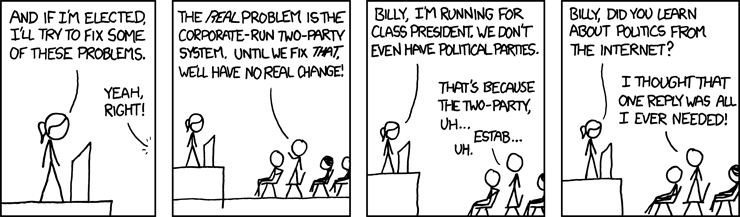
Today's xkcd had a funny take on modern politics. As usual, you'll have to go there to read the clever hidden message:

xkcd comic no. 661

Sometimes, you need to have more than one idea in your head at a time. For some reason, our founders thought it was important that citizens understand the issues the country is facing. That still seems like a good idea to me, because maybe then our politicians would have a better understanding, too.


Tuesday, November 10, 2009

Where Priorities Lead

Caption: Staff Sgt. Steven Atlas, a Chicago native, and a computer systems maintainer in Company C, 412th Aviation Support Battalion, works on his computer to check the status of the systems he must keep up and running.

You can't do this stuff without an education. This is an increasing concern to the nation's defense leaders.

Image credit: Sgt. Brandon Little/U.S. Army

An organization called Mission: Readiness formed recently to see what could be done to prepare the next generation of Americans for life in the military. This is a serious organization. Among others, it consists of Generals Hugh Shelton and John Shalikashivili, both former Chairmen of the Joint Chiefs of Staff (CJCS), General Wesley Clark, former NATO commander and Presidential candidate, several former top enlisted men and women of each of the services, and a whole busload of other former generals, admirals, and civilian DoD appointees. They released a report on Thursday that came to a very distressing conclusion:

[M]any young Americans who want to join cannot. Startling statistics released by the Pentagon show that 75 percent of young people ages 17 to 24 are currently unable to enlist in the United States military. Three of the most common barriers for potential recruits are failure to graduate high school, a criminal record, and physical fitness issues, including obesity.

Ready, Willing, And Unable To Serve (PDF)

The number of potential recruits who cannot join due to each of these three barriers is distressing, for different reasons. What all point to is that we have done a lousy job of preparing the next generations for life in the modern world.

Education and fitness disqualify roughly the same number of applicants. Adding up the numbers, roughly half of the 17 to 24 population either do not have a high school diploma, or cannot pass the basic test the military administers to test educational attainment:

Inadequate education: Approximately one out of four young Americans lacks a high school diploma. Students who have received a general equivalency degree (GED) can sometimes receive a waiver if they score well enough on the military’s entrance exam. However, most of those who dropped out and obtained a GED instead of a regular degree do not possess sufficient math or reading skills to qualify.
...
Even with a high school diploma, many potential recruits still fail the Armed Forces Qualification Test (the AFQT) and cannot join. The test is used by the military to determine math and reading skills. About 30 percent of potential recruits with a
high school degree take the test and fail it.

Ready, Willing, And Unable To Serve (PDF)

[emphasis from original]

While I can't claim to have taken the real test, I took this practice test in mathematics. I made things more difficult for myself by solving all the problems in my head. I still got 97 percent (58 out of 60) right. Then, I took this online practice exam for the Armed Services Vocational Aptitude Battery (ASVAB), and got a 95.5% grade. Here's the screenshot of the result:
Image credit: Screenshot of 4Test.com result page by Cujo359

The ASVAB is considered part of the AFQT. It contains what I'd call questions about specialized knowledge in auto maintenance and electronics. If you don't know much about those subjects, you can't expect to do as well. Still, that I could do that well when I was in a rush should show that a satisfactory grade is possible for someone who does a little studying. I graduated from college thirty years ago. If the real tests are similarly challenging, it's sad that anyone who graduates from high school can't pass it.

What's more, as the Raleigh-Durham News And Observer reports, the military is willing to give recruits all the help it can:

If they exceed the Army's weight standards, recruits can come to the station and run or do other exercises with Army personnel. If they don't score at least 31 out of 100 in a practice version of the Army's standardized aptitude test, they can use an online tutoring program to sharpen their math, language and science skills before testing again.

The military can issue waivers for almost any disqualification, but as the economy drives more people to consider military careers, waivers are harder to get.

Pool Of Military Recruits Increasingly Unfit

For those who get those waivers, opportunities will be limited. For those who can't cut it academically, most technical specialties will be off limits. For those whose health is not up to snuff, a career in combat specialties will be a non-starter.

The more important consideration, though, is that this is also an indication that these young people haven't been prepared for life outside of the military, either. The military needs people who understand science and mathematics for the same reason everyone else does - this is a world that requires knowledge of both. People who can't operate or understand computers, or who can't communicate well with their peers, are of little use in the civilian world, except in a few areas of employment. Poor health can limit employment opportunities as well.

What's more, the failure to prepare children for school in the first place has had a serious impact on the number of potential recruits who are disqualified by the third barrier, a criminal record:

“[S]chool readiness skills” are more than just learning the ABC’s or knowing how to count. Young children also need to learn to share, wait their turn, follow directions, and build relationships. This is when children begin to develop a conscience – differentiating right from wrong – and when they start learning to stick with a task until it is completed. Nobel-prize-winning economist James Heckman studies economic productivity and argues that these early social skills are crucial for future success in school and later in life. As Heckman explains, success builds on success. Unfortunately, failure also begets failure.
...
Evidence supporting pre-kindergarten for at-risk children comes from a randomized-controlled study following children in the High/Scope Perry Preschool Project in Ypsilanti, Michigan. Beginning in 1962, preschool teachers worked intensively with low-income children ages 3 and 4. The children attended preschool during the week and teachers came to their homes once a week to coach their parents on appropriate parenting skills. Researchers followed the children up to age 40, comparing their life experiences with the children who did not participate in the early education program. The contrast was stark.

Almost half of the preschool children were performing at grade level by the age of 14, compared with just 15 percent of the children in the control group; and 44 percent more of the children in the Perry program went on to graduate from high school.

By age 27, at-risk three- and four-year-olds left out of the Perry Preschool program were five times more likely to be chronic offenders than similar children who attended the program. Significant and meaningful differences in life outcomes continued through age 40.

Ready, Willing, And Unable To Serve (PDF)

Yet, congresspeople looking to score cheap points often label such programs "pork barrel" projects. Anyone who has paid any attention to the problem of educating children today realizes that often times the first few years of a child's life aren't spent in an environment that provides such experience. A little money would go a long way toward fixing these problems, but it appears our politicians would rather continue to support the prison industry.

The report's conclusions about the health of young people should be equally alarming:

Nearly a third (32 percent) of all young people have health problems – other than their weight – that will keep them from serving. Many are disqualified from serving for asthma, eyesight or hearing problems, mental health issues, or recent treatment for Attention Deficit Hyperactivity Disorder.

When weight problems are added in with the other health problems, over half of young adults cannot join because of health issues. Additional young people are not eligible to join because of drug or alcohol problems.

Ready, Willing, And Unable To Serve (PDF)

As I mentioned before, these are conditions that can make recruits for a civilian job less attractive, also, and can potentially disqualify them from many areas of employment. Many of these conditions can be treated, and in some cases ameliorated, by proper health care. This is yet another tragic consequence of our current health care situation.

It's a sad irony that while trying to build up our military strength over the last three decades, our government has often neglected to take care of the people and the institutions that make a modern military possible. We have allowed much of our manufacturing base to be exported to the rest of the world. We've neglected public education, and we've neglected our own health. Yet we've never failed to build weapons systems, and create new, complex directorates for building and testing these systems. Our weapons have become marvels of mobility and automation, at the same time that our children have become unprepared to handle them.

As a nation we seem to have lost the notion that the real strength of a country is in its people, not its weaponry. Our priorities have created a sadly ironic predicament.

By now, I'm used to the idea that our leaders really don't give a damn about the people they rule. That's readily apparent from the spectacle of this health care debate. But some day, they are going to have to wake up and realize that the next grand adventure they want to send the Army on probably isn't going to be feasible, because the Army can't find enough qualified applicants to fight it. You'd think that, if for no other reason than to save their own pathetic asses or spare their own children from fighting our wars, they'd take better care of the next generations.

Apparently, they aren't even capable of that sort of concern.


Thursday, September 17, 2009

Steve Harvey Is An Arrogant Bigot

There have been several times in the last couple of years when I've been moved to write that atheists are the one group in America that it's still OK to hate. Steve Harvey, a guy who is a standup comedian who thinks he is qualified to be a relationships counselor, provided a prime example of this on CNN recently:

BEHAR: Which reminds me, speaking of God, you say in the book that you wouldn't go out with a woman, I guess, a woman should not go out with a man that doesn't believe in God.

HARVEY: No, I mean, why would you?

BEHAR: Do you believe that only people who are religious are ethical and moral?

HARVEY: No. I just believe if you don't believe in God, then where is your moral barometer? That's just me talking. You can believe what you want to believe. But if you're an atheist, you're basing the goodness and morality on what? I mean, but what is an atheist? I don't really get into that. I've talked the people all the time. I'm an atheist. I just walk away. I don't know what to say to you. BEHAR: Well, an atheist is someone that doesn't quite believe that there is somebody out there, some God out there.

HARVEY: Well then to me you're an idiot.

BEHAR: OK. Well ...

HARVEY: I'm cool with that. Probably not the right politically correct thing to say but if you don't believe in God, I mean, really, you have to have an explanation for this. You can't just tell me it spun out of a gastrous (ph) ball and then all of a sudden we were evolved from monkeys. Why we still got monkeys? There is too much open. I just believe that and if you don't believe that, then I don't like talking to you.

BEHAR: I see. OK. Listen. Listen. It's fine with me.

HARVEY: Can you say that on Larry King?

BEHAR: You can say it on any show. It is a free country.

Larry King Show Transcript: May 29, 2009

Yes, he's free to say that. A good question would be why you're free to say that on CNN. He's been on at least once since then. He wouldn't be free to say that about an ethnic minority. He sure wouldn't be free to say that about Christians, but he can say it about atheists.

Steve Harvey is a bigot. Anyone who is willing to believe such things, particularly without having spoken to the people he's disparaging or having read any of their opinions qualifies as one. He must certainly be aware that some of the world's most prominent scientists, who are among the world's smartest people, are atheists. In fact, scientists are far more likely to be atheists than the general population. Yet Harvey, who has never demonstrated an actual mastery of any subject more complicated than a one-liner, dismisses them as "idiots".

I've known some bigots in my life. I've also known people who were not terribly thoughtful. Yet even they, when they are saying things like this, at least have had the grace to sound apologetic or somewhat ashamed of their view. Does Harvey sound apologetic, or embarrassed? The only thing he seemed concerned about is that he wasn't allowed to say what he did on that show. That takes some arrogance.

Normally, I wouldn't bother writing about this bigoted clown. This interview was three months ago, after all. He made the same assertion on Tyra Banks' show a couple of months earlier. I can't find any statement of contrition, apology, or reconsideration on his part. What's more, the sad fact is that a lot of people seem to believe the nonsense Harvey does. Here's a letter someone blessed the Des Moines Register with a few weeks ago, during the controversy about the atheist bus ads:

Having read Rekha Basu's Aug. 12 column, "Culver Sends Message of Unacceptance," I am perplexed by the logical inconsistencies atheists habitually live with. The aggrieved tone of the atheists' letter to Gov. Chet Culver indicates that they believe he did something wrong.

What does that even mean to an atheist? If there is no God and no absolute moral standards, then right and wrong, good and bad, mean nothing but "things I like" and "things I don't like."

A logically consistent atheist cannot make moral judgments of any kind about anything.

Atheists Can't Make Moral Judgments

By way of background, I covered Culver's comments last month. This writer, as you may have observed, has no problems with logic. He simply hasn't offered any.

What's more, it's clear that he's stumped as to why people would be offended when the governor of their state takes offense at their announcing that they exist.

I have a suggestion for this guy, Steve Harvey, and any other pig-ignorant bigot who wants to assert something like this without a shred of proof. Go to college. A lot. Study biology, physics, mathematics, and cosmology. When you know biology as well as this guy, know physics as well as this guy, mathematics as well as this fellow, or the cosmos as well as this man did, then maybe you'll have learned enough to show why there's a physical or mathematical reason why people can't learn morality without believing in your god. Maybe you can tell all those other "idiots" who missed it what they were doing wrong. Personally, I think you have about as much chance of that as you do of being struck by lightning with a winning Powerball ticket in your hand. Maybe less.

Why do I write that they're "pig-ignorant"? It's because you don't really have to resort to physical or mathematical proofs to show that morality can exist without believing in a Christian god. Societies all over the world have managed to develop prohibitions against murder, theft, lying, and adultery, which are most of the things covered by the Ten Commandments that don't have to do with how to worship. Yes, they don't get all the details right, like whether one is allowed to drink alcohol or eat sausages and cheeseburgers, but they got the basics down without believing in the god of Jews, Christians, or Muslims. In fact some don't believe in gods at all.

So, whether you accept that there is no physical reason why people can't have morality without gods, there's clear empirical evidence that it isn't necessary. Maybe there's some innate morality we all have. Maybe there's an evolutionary pressure on societies that makes the unstable ones disappear. Maybe people just figure out one day that stoning people for eating cheeseburgers isn't a cool way to run a society. Whatever the reason, it clearly isn't belief in Steve Harvey's bearded guy in the sky.

So, the man is ignorant as well as a bigot. That doesn't stop television people from putting him on the air. As long as that continues to be true, I suppose the best thing is for more of us to write about what a tiresome asshole he is until he learns better.

As arrogant and ignorant as he is, my guess is that it will be a long, long time.

(h/t Greg Laden)


Tuesday, September 15, 2009

In The Birthplace Of The American Print Industry

Image credit: The Franklin Institute

That rumbling you hear is Ben Franklin turning in his grave. The Free Library of Philadelphia, one of the oldest and biggest in the country, is closing its doors thanks to a budgetary crisis in Pennsylvania:

All Free Library of Philadelphia Customers,

We deeply regret to inform you that without the necessary budgetary legislation by the State Legislature in Harrisburg, the City of Philadelphia will not have the funds to operate our neighborhood branch libraries, regional libraries, or the Parkway Central Library after October 2, 2009.

FLP Closing

Philadelphia's most famous citizen almost started the print and news business in this country singlehandedly, by importing and then selling at rock-bottom prices the printing presses used to publish the colonies' first newspapers and handbills. Now, its public library is closing its doors, because politicians can't seem to do the right thing.

The supplemental budget for states and municipalities in the stimulus bill passed last April was, by any reasonable standard, wholly inadequate. But, as crankylitprof explains, that's not the only level of government that's failing:

Why is it closing? because the douchetards in Harrisburg, PA, led by their miserable, wretched, disingenuous, cheese steak-snarfling fat fuck of a “Governor,” Ed Rendell, can’t manage to pull a budget out of their gaping, wart-raddled, pecker-ridden asses.

Is Ben Franklin Gonna Have To Smack A Bitch?

For those not familiar with Pennsylvania dialects, allow me to interpret. The PA legislature has been avoiding passing a budget for some time. Thanks to their inaction, Philadelphia is having to close the library system, not to mention laying off police and firemen, and setting 1000 traffic signals to flashing (PDF) by mid-October. It can fairly be observed, as crankylitprof does, that the Philadelphia city council and mayor aren't depleting their staff very much, but there's plenty more blame to be spread at the state level.

These disputes nearly always come down to taxes, and this seems to be no exception. Tax revenues are down everywhere, and states have to balance their budgets. PA has a much lower tax rate than Delaware's (about 71% of Delaware's in 2005), New Jersey's (79%), New York's (82%), and Maryland's (92%). Of its neighbors, only Ohio has a (slightly) lower per capita state tax level. There has to be some wiggle room there. Yet the state legislature seems unwilling to bite the bullet.

This economic crisis has been largely due to the federal governments refusal to act when it would have made a difference, and refusing to do enough afterward. I suppose expecting a state legislature, particularly Pennsylvania's, to be any different is unrealistic.

(h/t Earthbound Misfit)


Saturday, September 12, 2009

Greenwald Makes Sense Of It All

Today, Glenn Greenwald made sense of the Right's reaction to President Obama's first year in office:

Nothing that the GOP is doing to Obama should be the slightest bit surprising because this is the true face of the American Right -- and that's been true for a very long time now. It didn't just become true in the last few months or in the last two years. Recent months is just the time period when the media began noticing and acknowledging what they are: a pack of crazed, primitive radicals who don't really believe in the country's core founding values and don't merely disagree with, but contest the legitimacy of, any elected political officials who aren't part of their movement.

Is The Right's Attack On Obama's Legitimacy New Or Unprecedented?

With all the nonsense I've been reading lately about how partisan things have become recently, it's refreshing to read someone writing what has been obvious. The Right hates anyone who isn't with them, pure and simple. Rep. Wilson's outburst wasn't an aberration. He's either one of, or playing to, the people who have been whining for months that their country is being taken away.

These are people who have, quite literally, created their own reality and continue to live in it. Take for example this tidbit from one of Talking Points Memo's readers:

Was having a drink with a friend at a fancy downtown bar when two well-dressed men start chatting with us. Seemed friendly and normal enough until one asks how big we think the march tomorrow will be -- "250,000? They say all the hotels are full!" I ask, "Are you here for that?" -- and get an earful about how Medicare has a $35 trillion unfunded liability, every letter you mail costs $1 is taxes, and Obama is a Manchurian candidate who wants to create a million-person national civil defense force with a budget equal to the Penatagon's.

Into the Teabag Vortex

It's hard to believe that people are so divorced from reality that they believe stuff like this. Unfortunately, as I mentioned yesterday, one needn't look very far to see the same sort of schism between reality and belief on our side. The idea that Obama, or any other politician for that matter, could somehow rise above this surreal political environment we've created is breathtakingly absurd.

Maybe when we as a nation, and our news organizations in particular, start to realize that all ideas are not created equal, perhaps then we'll start to see someone emerge who can get us to talk to each other. But when one side thinks that the other's leaders are all murderers, lesbians, or foreigners, and the other side are willing to believe that their adversaries' leaders would casually murder thousands of their countrymen without even a shred of proof, this isn't going to happen.


Friday, September 11, 2009

The Lesson Of 9/11

Image credit: National Park Service

It's September 11 again. In the eight years since the traumatic events of this day in 2001, we seem to have drifted into the most profound funk imaginable. If you want to know where we are today, I suggest you read Scarecrow:


I’m 65. I’ve lived through McCarthyism, racism and race riots, the civil rights movements, Berkeley in the 60’s, three assassinations, Nixon and Watergate. I helped kill some people in Vietnam and called in Medevacs for others, for no reason I can account for, and I’ve watched the American addiction to imperial adventures drag us into one quagmire after another. I lived and worked through the rise and neglect of environmentalism, Carter’s hapless energy wars and Reagan’s mindless wars against governance, science and rationality. I've watched the zealots of the nation's self-declared official religion become increasingly detached from reality and its humane commandments.

Slouching Away from 9/11

How we got here is a little harder to tell, at least for me. Certainly the fear and selfishness Scarecrow mentions are part of it. But I think it really comes down to our growing love of ignorance and stupidity. What we have done in the last few years, we mostly did because we were too badly informed to know what the right course of action was. Many let the government convince them, on the basis of mere assertion, that the Iraqis were responsible for the attacks, and that they were also stockpiling nuclear weapons. These assertions were all tragically false, as anyone who looked at the basis for them skeptically would have realized. Yet there were many people who were happy to believe, thanks to their abiding prejudices about Muslims and Arabs.

Not to be outdone, some people who were against the war and somehow recognized the mendacity behind it, came to believe in their own fallacy - that it was their own government that was responsible for the 9/11 attacks, not foreign religious fanatics. They, too, believed nonsense based on little more than assertion, because their predispositions led them to, and because their lack of critical thinking skills and knowledge left them without the tools to understand the absurdity of what they were being told.

The number of times I've been told by disciples of both these irrational beliefs that I need to open my eyes and see the truth, or that I'm willing dupe of whoever they were afraid of, are too numerous to mention. Look at these comments for some small idea. Arguing against mistaken ideas is pointless after a while. The people who still believe them won't change their minds, no matter how much evidence is presented. To this day, the WMD cult thinks that they were out there somewhere, and now they've been moved. Maybe they were moved to Syria, or the North Pole. "Truthers" beliefs have grown similarly wackier over time. Whether it's due to emotional investment in a belief, or just not wanting to admit they were wrong, most of these people will cling to their beliefs to the bitter end.

When we as a people can believe so easily and so willingly in nonsense, it's not hard to see that whenever we debate anything, whether it's war, or health care, or economic policy, that we can't help but get into the sort of nonsensical discussions we have. The best advice I can give to Americans is, when we are discussing matters of this importance, to try to check your assumptions at the door.


Wednesday, September 2, 2009

Well, Lookee Here

My old alma mater excels at something besides football. Washington Monthly has released their list of the best colleges for 2009, and The Pennsylvania State University came out pretty well:


Rather than rate a school by how famous its graduates are or how their presidents feel about them, Washington Monthly rates colleges according to how much research they do, how many of their students do public service, and how well they contribute to upward mobility. As can be seen by that red '3' in the right hand column, PSU excels in the third category. It has a higher graduation rate than expected, and has a large number of students who qualify for Pell Grants. It does pretty well at graduating PhD's in science and engineering, too.

Hey, it might not be as satisfying at being number one in a sport where large men push each other around in the mud, but we'll take it.


Friday, August 28, 2009

The Economy Of Unreason

Caption: A telescope used for Moon viewing at the Japanese Gardens at The Arboretum, in Seattle, Washington.

Image credit: Cujo359

It's hard to describe the cognitive dissonance that followed reading these two articles this morning. The first is from Dana Hunter at En Tequila Es Verdad:

Learning is one of those endeavors without end. If you stop at a taste, you may believe you've been sated - I know people like that, people who nibbled at knowledge and then wandered away in favor of something easier. Maybe it's because they were force-fed rather than allowed to develop an appetite. Perhaps they came to believe learning was too hard, or they weren't good at it, or some other bollocks. If they're lucky, later in life, they'll get a second chance at the buffet and realize they've been starving all along. Maybe they'll realize how much they need to know.

Maybe they'll wander down to Ballard Locks and see a man with a telescope.

Wait a second, you say - a telescope at boat locks? In broad daylight? That's one of the things I love the most about this city, the incongruity of enlightenment, lodged in the most unexpected places. My friend and I headed down to watch the boats travel between Lake Union and Puget Sound, and stumbled into an astronomy lesson. A gentleman had his telescope set up on the lawn across from the visitor's center, pointed at the sun. He had a passel of people there waiting for their chance to have a close look. And while they sat and stared in awe at solar prominences and the mottled texture of the sun's surface (yes, it really does look like an orange peel), he gave a little lesson on our nearest star. All for free.

Need to Know

We humans have a need to learn. It is wired into us. Our minds are like machines that are ready-made to make guesses about how our universe works. When those machines lack quality fuel, like a good education and an intellectually stimulating environment, they often make inferences that are, shall we say, gravely mistaken. As psychologist and skeptic Michael Shermer explains:

Why do people see faces in nature, interpret window stains as human figures, hear voices in random sounds generated by electronic devices or find conspiracies in the daily news? A proximate cause is the priming effect, in which our brain and senses are prepared to interpret stimuli according to an expected model. UFOlogists see a face on Mars. Religionists see the Virgin Mary on the side of a building. Paranormalists hear dead people speaking to them through a radio receiver. Conspiracy theorists think 9/11 was an inside job by the Bush administration. Is there a deeper ultimate cause for why people believe such weird things? There is. I call it “patternicity,” or the tendency to find meaningful patterns in meaningless noise.

Traditionally, scientists have treated patternicity as an error in cognition. A type I error, or a false positive, is believing something is real when it is not (finding a nonexistent pattern). A type II error, or a false negative, is not believing something is real when it is (not recognizing a real pattern — call it “apatternicity”). In my 2000 book How We Believe, I argue that our brains are belief engines: evolved patternrecognition machines that connect the dots and create meaning out of the patterns that we think we see in nature. Sometimes A really is connected to B; sometimes it is not. When it is, we have learned something valuable about the environment from which we can make predictions that aid in survival and reproduction. We are the descendants of those most successful at finding patterns. This process is called association learning and it is fundamental to all animal behavior, from the humble worm C. elegans to H. sapiens.

Unfortunately, we did not evolve a Baloney Detection Network in the brain to distinguish between true and false patterns. We have no error-detection governor to modulate the pattern-recognition engine. (Thus, the need for science with its self-correcting mechanisms of replication and peer review.)

Patternicity

What turns an inference into a mistaken belief is lack of knowledge, coupled with a lack of willingness to try to expand that knowledge through learning and reason. The many mistaken beliefs in our culture, creationism, 9/11 denialism, birthers, and so on, are a product of these lacks. As a society, we seem to be becoming more ignorant and unreasoning, even as our knowledge increases. Why this is has at least as much to do with our lack of interest in education and learning as it does to anything.

Which brings us to the other article, which was on National Public Radio, about one more gift left to us by the Bush Administration. It concerns the end of the Public Broadcasting System's (PBS) series Reading Rainbow:

The show's run is ending, [WNED manager John] Grant explains, because no one — not the station, not PBS, not the Corporation for Public Broadcasting — will put up the several hundred thousand dollars needed to renew the show's broadcast rights.

Grant says the funding crunch is partially to blame, but the decision to end Reading Rainbow can also be traced to a shift in the philosophy of educational television programming. The change started with the Department of Education under the Bush administration, he explains, which wanted to see a much heavier focus on the basic tools of reading — like phonics and spelling.

Grant says that PBS, CPB and the Department of Education put significant funding toward programming that would teach kids how to read — but that's not what Reading Rainbow was trying to do.

"Reading Rainbow taught kids why to read," Grant says. "You know, the love of reading — [the show] encouraged kids to pick up a book and to read."

'Reading Rainbow' Reaches Its Final Chapter

In a country that seems to be drowning in ignorance, no one can find a few $100k to keep a show on the air that teaches children why learning and reading is important. I suppose I shouldn't be surprised. The Bush Administration, after all, had no use for science when it didn't fit in with their propaganda. George W. Bush bragged about never reading newspapers. If there was ever an Administration less interested in intellectual endeavors, I haven't had the misfortune to live under it.

Learning to be a skeptical, smart, observer of the world is a difficult thing. It requires acquiring an education, which requires considerable effort. That effort is often at the expense of doing other things that might be more fun, like going to movies, playing video games, or just hanging around with friends. As Dana wrote, it's an effort that has to continue for the rest of a person's life. For anyone who doesn't find that effort intrinsically fun, there needs to be some inspiration. That doesn't come from something as prosaic as wanting to earn a living when you're a child. Helping children realize that reading and learning can lead to interesting experiences can help provide that inspiration.

With our population seemingly becoming more ignorant by the day, it's a shame that we place so little value on inspiring our children to be more interested in learning. The money spent on Reading Rainbow wouldn't put a new coat of paint on an F-22. Yet we can't manage to find the means.

Maybe someone can take the money they saved on Reading Rainbow and add a few more explosions to the next Masterpiece Theatre. In a few years, that's what their audience will be looking for.


Monday, August 24, 2009

Somehow, I Don't Feel Smart

Updated at 1:30PM

Image credit: Generated by the quiz

Dana Hunter mentioned this science quiz over at En Tequila Es Verdad:

How are we supposed to feel all super-superior and stuff when that's the level of difficulty? I'd feel proud of my results if I were better than, oh, say, 5% of the country. But to be in the top 10% with questions that bloody simple - that's like beating a bunch of drunk people at coordination tests. It's bloody meaningless, is what it is. A Pyrrhic victory of sorts.

How ... Sad

Thankfully, I don't have to admit being dumber at taking this quiz than Dana or George W., whose article tipped Dana off:

I took the Pew Research Center Science Quiz, and got 100%, so I should be happy. But I’m not, because the questions were really easy (every single one has been in the news lately) and I read the “scores by demographic” part. It gave me that “we’re all doomed” feeling.

A Depressing Score

Four of the questions, two of which were about the solar system and two related to biology, represented recent knowledge. I think if you had much knowledge of the solar system, those would have been easy to guess. The biology questions have been discussed endlessly both in the news and popular entertainment. The others were about knowledge that's been around for decades. As with knowing who gave the Gettysburg address, you can't feel special about knowing this stuff. Yet it's more than 90% of the people who took it seem to understand, and that is depressing.

Looking at the demographics really is depressing:
Image credit: Generated by the quiz. Screenshot by Cujo359

The biggest underachievers are college graduates. I can see not knowing something, or forgetting one or two things over time, but if you're a college grad between the ages of 22 and 60 and have no medical problems that affect your mind, and you can't score 11 out of 12, you really ought to be ashamed. It's also sad that young people don't know more of these things. As George wrote, most of this is discussed on TV and in other communications media quite a bit. Of the knowledge that's been around for decades, nearly all of it I learned in high school.

The Pew Research study this test came from is an interesting read. On the one hand, it is clear that the general public supports science and technology, and thinks that these are positive forces in their lives. On the other hand, as this test bears out, the public isn't terribly well informed about science and engineering, or about how they work:

While the public holds scientists in high regard, many scientists offer unfavorable, if not critical, assessments of the public’s knowledge and expectations. Fully 85% see the public’s lack of scientific knowledge as a major problem for science, and nearly half (49%) fault the public for having unrealistic expectations about the speed of scientific achievements.

Public Praises Science; Scientists Fault Public, Media

Science and engineering are intellectual processes toward achieving an end. In the case of science, that end product is knowledge, and it may come in a form that the scientists hadn't anticipated. Engineers use scientific knowledge to create something, and that, too, is a process that is subject to both reassessment and error.

Yet the public, whose understanding of these processes seems to be based on the things they see in TV shows, seem to know little or nothing of how these disciplines operate.

We see this ignorance play out in debates on the causes of 9/11, the supposed dangers of vaccines, and creationism. In the case of 9/11 "truthers", I love being lectured about how the laws of physics work by people who, in most cases, clearly don't understand them. These statements, though, reveal a more fundamental misunderstanding of the relationship between science and engineering. Any engineer, when confronted with such a statement, first has to ask "Which physics are we talking about?" We use the physics that apply to a given situation. Civil engineers use classical physics, and pay little attention to quantum mechanics or relativity. Electronics engineers mostly pay attention to quantum mechanics. Even within those specialized fields of physics, there are concepts that apply in particular designs, and concepts that can be safely ignored. Part of engineering is figuring out what the correct things are. Any civil or mechanical engineer who thinks that steel has to melt before it can fail to hold its designed load needs to find another line of work.

Belief in creationism flies in the face of most of what we've learned about our world in the last three centuries. Yet more than half of Americans think it might be true.

As bad as the lack of knowledge of the basic facts of this quiz may be, I think it's worse that the public doesn't seem to understand how it is that the scientists who discover them and the engineers who create them do their jobs.

For example, the Pew study observed:

Most scientists had heard at least a little about claims that government scientists were not allowed to report research findings that conflicted with the Bush administration’s point of view. And the vast majority (77%) says that these claims are true. By contrast, these claims barely registered with the public – more than half heard nothing at all about this issue. Only about a quarter of the public (28%) said they thought the claims were true.

Public Praises Science; Scientists Fault Public, Media

The free exchange of ideas is vital to science. Without it, errors will go uncorrected. Yet few in the public were aware of the Bush Administration's deliberate censorship of scientific discussion. In all likelihood, few of them realize what a disaster such policies can be for science, and for engineering and medicine.

Image credit: Pew Research

Which brings me to one final point. This study had one result that I've seen widely quoted in progressive blogs:

Yep, the smart people tend to be liberal, at least when they're not rich. So, when people say that 70% of Americans agree on something, what you should be thinking is, which 70 percent? Is it the 70 percent who couldn't answer at least ten of these ridiculously easy questions? The seventy-plus percent who didn't know that the Bush Administration was censoring government scientists?

In that case, I'll be happy to be part of the minority.

UPDATE: Added many more expository links and a bit of editing.


Monday, March 16, 2009

Are You Bored Now?

Image credit: Screenshot of The Daily Show by Cujo359

One of the things that struck me about Jon Stewart's evisceration of Jim Cramer last week is that in a truly educated society, Cramer would have just been a loudmouthed nobody to begin with, at least based on his work for CNBC. As Stewart demonstrated, he was consistently and sometimes spectacularly wrong about companies that he featured on his show. His Twenty-Five Rules of investing, while generally sound advice, are mostly the sort of commonsense stuff that no one with a college education should need to buy a book to understand. Yet his Mad Money books sold like hotcakes. All Stewart had to do was look at Cramer's past pronouncements on specific stocks, and show the videos in which Cramer basically pooh-poohed any indications of trouble when, in fact, the things were days away from tanking.

Prior to this interview, my only impressions of Cramer came from seeing him on cable TV as I was trying to tune into something that wasn't CNBC. I wondered why anyone would pay attention to him. He struck me as an arrogant man who tended to make his point by belittling or shouting down anyone who disagreed with him. Such people seldom turn out to be thoughtful.

It's no irony that Stewart strikes me as one of those people who, when they were kids, never asked "why do I have to learn this stuff? It's boring!" Of course, it's possible that he did, and he was lucky enough to have known someone like my father at the time.

Yes, I once asked that question. In fairness, I was ten years old at the time. I barely knew what it was I was learning, let alone why. Like most kids, I didn't like learning mathematics. One night, my father collected some of his old engineering and science textbooks together, and showed them to me. As I looked at page after page of incomprehensible equations and tables, he tried to explain, as near as I can remember, that mathematics was one of the tools we need to understand the universe. To truly understand the world, you need to understand math.

You also need math skills to communicate that understanding to others, and you'll need language skills. You need to be able to construct coherent sentences and paragraphs, and string them into coherent lines of reasoning or a sensible story. That's why it's important to learn English, or whatever language you speak.

We seem to be a nation full of people who asked that question, and never got a good answer. A close relative of mine was telling me a story about the place she worked recently. Her company was having some sort of trivia contest. One of the questions was "Who delivered the Gettysburg address?" The company she works for is less than 150 miles from Gettysburg. Believe it or not, surrounded by college-educated people, she was the only one who knew.

Why do you need to learn about history, you might ask? It's just a bunch of facts and dates and stuff. I give you George Santayana:

Those who cannot remember the past are condemned to repeat it.

And, I might add, among the condemned will be those who never learned about it in the first place.

President Lincoln gave the address weeks after the Battle of Gettysburg. That battle, the largest ever fought in North America, changed the course of the Civil War. Had the Union lost it, we might have become two countries, one that tolerated slavery and one that didn't. Our history since then, with perhaps a quarter of our population and resources gone, would have been very different. We would no doubt have been rivals, assuming that we never got back together. The Monroe Doctrine might have ceased to matter. Our current politics would have been almost unrecognizable, with the remaining United States being a progressive society that would have put Europe and Canada to shame, instead of the other way round. Or, we could have been involved in ruinous wars for the next half century.

Slavery, and the racism it caused, continues to haunt our politics today. It is one of the reasons we have a Senate that is not representative of our populations, and it is one of the reasons that the filibuster, a device that often makes our current Senate ineffectual, has continued as an institution for so long.

Anyone wanting to understand our current political situation needs to understand the results and implications of the Civil War. More than any event after the Revolution, it shaped the country that we are now.

Writers could learn lessons from that speech, too. They could learn that, as one of Shakespeare's characters put it, brevity is the soul of wit. That address, so short in comparison to the other speeches given at the dedication of the cemetery that day, was easily the most memorable. It was memorable mostly because it was able to encapsulate the feeling and hopes of that moment in fewer than three hundred words.

Of course, all one needed to remember to answer that trivia question was that Gettysburg was a major battle of the Civil War, the President gave an address at the cemetery a few weeks later, and that Abraham Lincoln was the President at that time. And yet, it was a poser. Clearly, there are a great many people in this country who don't understand one of the most important events in our country's history.

When I wrote this article about the causes of the banking crisis, I used mathematics that I learned in high school. Admittedly, the experience of buying a house gave me an insight into the situation, as did some understanding of economics. Nearly every college graduate should have had the economics knowledge, though, and I think that most people who haven't attended college could figure out the basics. They should, at least. Yet this too, seems beyond most peoples' comprehension in America. I've heard and read so much obvious bullshit being thrown around on this issue that I'd have thought we were discussing quantum mechanics or brain surgery. There's a considerable amount of special knowledge required to understand a national economy, assuming that anyone actually does. Nevertheless, the facts clearly do not support the idea that this crisis was caused by "sub-prime" mortgages forced on banks by the government. All you have to do is look at the numbers. Losses from other forms of real estate loans, including so-called "prime" loans, dwarf those from the sub-prime portion, and there are more losses that have little or nothing to do with real estate.

Wonder why you need to learn civics? What's all that stuff about the branches of govenrment, and who cares what habeas corpus means, anyway? Why should you know what's in the Bill of Rights?

We've been in a slow slide toward dictatorship for the last ten years or so. The Congress, which is supposed to be an independent part of the government that makes the laws and decides on a budget, has simply ceded that authority to the President. The President, in turn, has decided that he doesn't have to be bound by any of those laws and budget things if he doesn't want to. And I'm not just talking about the last President, either. We're a few years away, at most a couple of decades away, from having no freedoms worth mentioning, and it's doubtful that most people will have noticed even then.

All those rights that TV cops are always complaining about aren't there to protect criminals. They're there to protect you from your government. Without those rights, and the rule of law, the government has nearly unlimited resources with which to destroy you or any other person it deems to be a problem. Without representative government, which in our government is Congress, the government will do whatever it feels like, whether or not it's good for the country.

That's why civics is important. If you don't know how your government is supposed to work and why, it will work however it damn well wants to, and it will run right over anyone who gets in its way.

Jim Cramer is certainly a part of the problem, as are the others like him. He justly deserved being humiliated on national TV. His employer, CNBC, must shoulder some of the blame. But in the end, we as citizens bear responsibility as well. When we have had the choice between quality news sources and news shows that are entertaining, we've chosen the latter far too often. When faced with complicated choices, we focus on irrelevance, on trivia, and on nonsense.

People who understand science and statistics wouldn't be afraid of immunization.

People who understand engineering, construction, and controlled demolitions wouldn't believe that someone demolished the WTC when it was full of people, and surrounded by people. People who have the least understanding of logic wouldn't have believed that the Clintons had Vince Foster killed, for that matter.

People who knew as much about biology, chemistry, and physics as I did when I graduated from high school wouldn't believe in creationism.

People who had some idea that people in the rest of the world have their own concerns and problems wouldn't believe that they award Nobel Prizes on the basis of what will piss off our President.

We waste so much time and energy on nonsense that shouldn't even be a consideration that it's no wonder that we don't even pay attention to the stuff that's killing us. If we ever do get around to those issues, people inevitably focus on trying to figure out who sounds the most confident, or who is better dressed, because they have no fucking idea what anyone's talking about. Either that, or the politicians concentrate on speaking in sentence fragments about feelings and "morality", lest anyone be confused.

We can't exist as a nation if the people who vote are as uninformed as this. So I have some advice for all you folks who are wondering how it came to be that guys like Jim Cramer got away with what they did for so long - get a clue. Cramer got away with it, as has the news business in general, because you, collectively at least, were too damn ignorant to figure him out, and because you wanted to be entertained more than you wanted to be informed. The modern world isn't a place for ignoramuses.

And you kids, when you wonder why you have to learn all that seemingly meaningless and difficult stuff, learn it. It's important. You'll find out why later. Plus, you'll be less ignorant and foolish than your parents and grandparents. That alone should make it worth the effort.